We focus on the fundamentals of aerodynamics, thermodynamics, turbulence and mixing with applications in propulsion, flight and energy.
A&A students study aerodynamic performance first-hand by testing scaled models in our historic Kirsten Wind Tunnel, while researchers address current topics such as ice accretion and its effect on aircraft stability and control, aeroelasticity and aeroservoelasticity; the development and use of numerical methods and algorithms combined with high-performance computing for simulations of aerodynamic and single/multi-phase turbulent flows; the development of new and advanced quantitative experimental flow imaging techniques such as three-dimensional particle tracking velocimetry (3D-PTV) for experimental investigations of turbulence, aerodynamics, reacting and multiphase flows, and cardiovascular flows; detonation-wave engines; relaminarization using stationary vortices; and the effect of Mach number on the turbulent boundary layer.
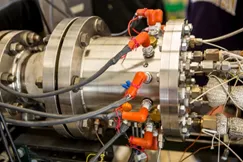
Fluids research extends into the realm of combustion and propulsion. We advance engine technology by looking at how detonation-based propulsion systems increase cycle efficiency. The combustion and evaporation condensation characteristics of cryogenic propellants are examples of other current research topics relevant to space propulsion systems. The high enthalpy steam facility is used for the study of chemical reactions in supersonic flows and testing of hypersonic thermal protection systems. Our facilities support small scale rocket firing tests in support of student aerospace laboratory experiments and the Space Systems capstone design course.