We lead controls research, the design of algorithms and techniques to enable systems to independently perceive, reason, and act within their environment.
We offer courses in the guidance, navigation, and control of unmanned aerial systems as well as the optimization and control of networked systems and hands-on training in aerospace instrumentation. Controls research in A&A spans the full range of the field, from the mathematics of stability and estimation to the practical challenges of building autonomous systems that work in the real world. Our students work on guidance, navigation, and control of unmanned aerial systems; optimization of networked and multi-agent systems; bio-inspired engineering; and model predictive control. A thread running through all of it: developing tools that handle the temporal, spatial, and nonlinear complexity that autonomy demands.
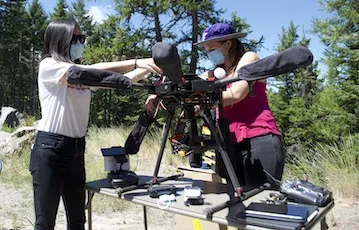
A&A undergrad and graduate students have the opportunity to explore practical applications for autonomy by gaining flight-testing and field operations experience with interdisciplinary collaborators and partners.
Key research areas
- Automatic control
- Autonomous vehicle control
- Control theory
- Dynamics and optimization
- Flight operations
- Human-robot interactions
- Safety-critical control
- Underwater vehicle design
- Unmanned aerial systems