
Amy Sprague
October 15, 2026
New research from A&A's Illimited Lab finds that an orb weaver spider designs its web to facilitate sensing the direction and size of prey through the rocking of its own body. The design principle behind it could give aircraft wings, satellites and lunar habitats the ability to sense impacts and damage, with fewer parts.
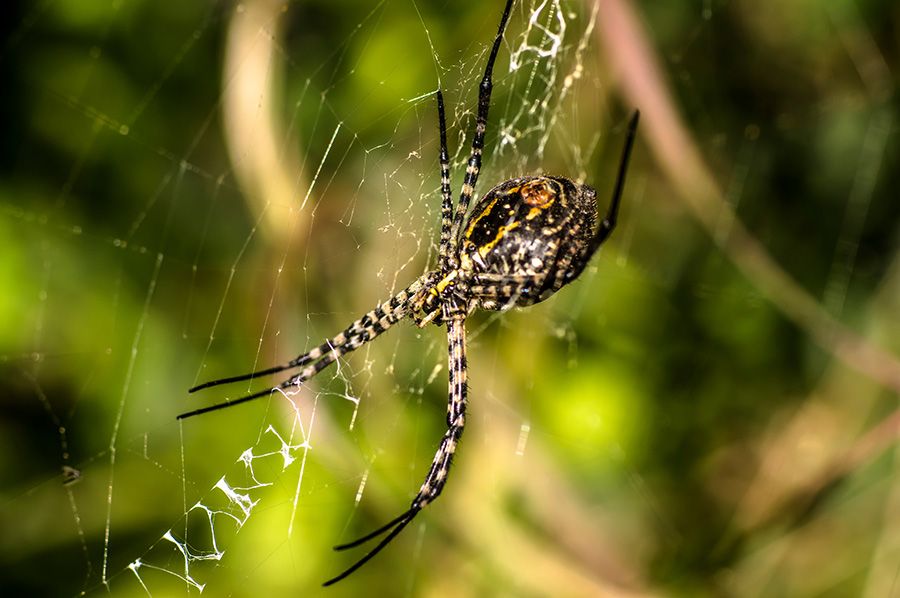
The banded garden spider (Argiope trifasciata) builds its web so that it reveals exactly where prey hits and how big it is.
A cricket jumps into a spiderweb. Roughly 35 milliseconds later, before the spider could have processed much of anything, its body has already turned toward the insect.

Ed Habtour, A&A Assistant Professor
The spider has poor vision and a small brain. The web it builds is lopsided and irregular. For decades, the leading explanation for how it locates prey so fast has been that each of its eight legs samples the vibrations traveling along the silk threads it happens to be touching, and the spider assembles those signals into a direction. That would require the spider to carry a detailed map of its own web and to interpret eight streams of complex information arriving at slightly different moments.
A new study published in Scientific Reports by Assistant Professor Ed Habtour and Thijs Masmeijer (A&A Ph.D. '25), now at the University of Twente, and colleagues at the University of Ljubljana and the University of Akron, argues that something much simpler is happening. The web is doing much of the work.
When prey hits a spiderweb, the whole structure deflects in a few dominant low-frequency patterns, and the spider sitting at the hub rocks with it. The rocking is stronger in one axis than the other, and the strong axis points at the prey.
"Wherever the rocking motion is highest, that's where the prey is," Habtour says.
The team tracked ten high-speed videos of Argiope trifasciata spiders catching crickets. In every one, the spider's body rotated toward the impact. The researchers then ran thousands of computer simulations and 74 physical experiments on 3D-printed webs made of a flexible polymer, testing shapes from nearly symmetric to badly off-center. The directional cue held up in all of them.
Size comes through the same channel. The bigger the rotation, the bigger the prey. A prey mass equal to about a tenth of a fruit fly was enough to reshape how the web moved.
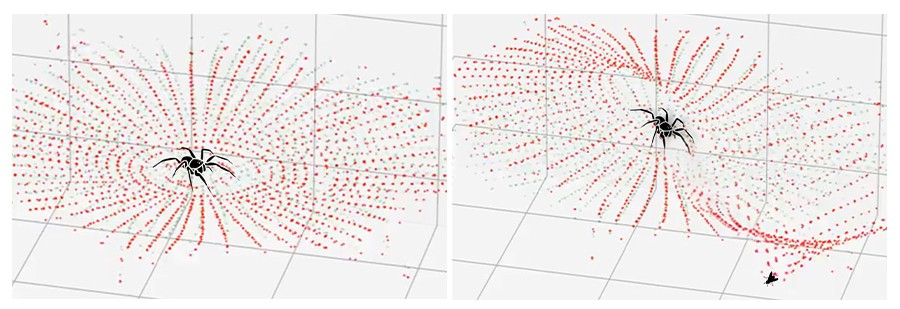
A visualization of a spider at rest at the hub of its web (left) and the resulting contortion in the web after a fly gets stuck. The motion in the web indicates to the spider where and how big the caught insect is.
The challenge is cultural. There's no functional reason for an antenna to be flat or for a grid to be square, but humans are comfortable with things that are flat and straight. We need to change how we teach mechanical design.
Ed Habtour
A&A Assistant Professor
Habtour describes the way the web is built as an example of mechanical intelligence, where a structure’s shape and materials do work that would otherwise require added parts. Here, that work is sensing. The capability lives in the structure itself, in its shape and materials, instead of in components added from outside. That runs against how engineers normally give a structure the ability to sense. When we need to know what is happening to a wing or a satellite panel, the usual solution is to add hardware. The structure holds the load, and the added electronics do the thinking.
"The traditional way is to embed piezoelectric materials, embed sensors everywhere, collect the data, process the data," he says. "But the spider doesn't have the budget for fancy sensors. It builds the web in an intelligent way, making it eccentric to amplify the rotation in one direction more than the other. It feels from how it rocks which way prey is."
An airplane wing is not so different from a web. Both are flexible, manage loads, and move in ways that depend on what just hit them. A Dreamliner wing flexes dramatically in flight up to 26 feet, by design, and that flex carries information: whether a bird struck it, how strong turbulence is, how the structure is holding up.
Today that information is read by instrumentation added to the wing after the fact, laid out in straight lines and square grids, and processed using complex algorithms. The implication of the spider work is that if the fibers inside the wing were arranged the way a spider arranges silk, the wing's own motion would point to the damage, and a single sensor at the right spot–-at a hub–could read it.
"If you think about the spider and the web, the web is the structure and the spider is the sensor," Habtour says. "So I can put one sensor on a structure instead of hundreds."
The same logic applies to inflatable habitats, deployable antennas and the tensioned membranes NASA has tested for atmospheric reentry. On the Moon, where micrometeorites are a routine hazard and sending an astronaut outside to inspect a habitat is a serious risk, a structure designed to rock informatively could report an impact and its location on its own.
What stands between the lab and the hangar or habitat, he says, is not the technology.
"The challenge is cultural. There's no functional reason for an antenna to be flat or for a grid to be square, but humans are comfortable with things that are flat and straight. We need to change how we teach mechanical design."
Go to the sources
- T.C.P. Masmeijer, J. Slavič, P. De, T.A. Blackledge and E. Habtour. Spiders’ gyroscopic motion via web mechanical intelligence facilitates prey sensing. Sci Rep (2026).