
October 12, 2026

Alan Kaptanoglu
For Alan Kaptanoglu, returning to the University of Washington is a lot like coming home.
Kaptanoglu earned his Ph.D. in physics at the UW in 2021 and remained connected as an affiliate assistant professor of mechanical engineering. He now returns as an assistant professor in A&A.
His work brings together applied math, scientific machine learning and nuclear fusion. He develops computational tools that help researchers model, predict and control plasmas, as well as other complex systems that change over time.
"I am so excited to join the A&A Department to build a collaborative research program with the fantastic plasma, controls, and materials science groups here. And as an avid hiker and climber, it is great to be back in the PNW," Kaptanoglu says.
Fusion is the reaction that powers the sun. It could one day provide low-carbon energy to the grid. Much of Kaptanoglu's research focuses on stellarators – fusion devices that use powerful magnets to confine superheated plasma. Designing those magnets is one of the biggest challenges in the field. They have to produce a very specific magnetic field while remaining practical and affordable to build.
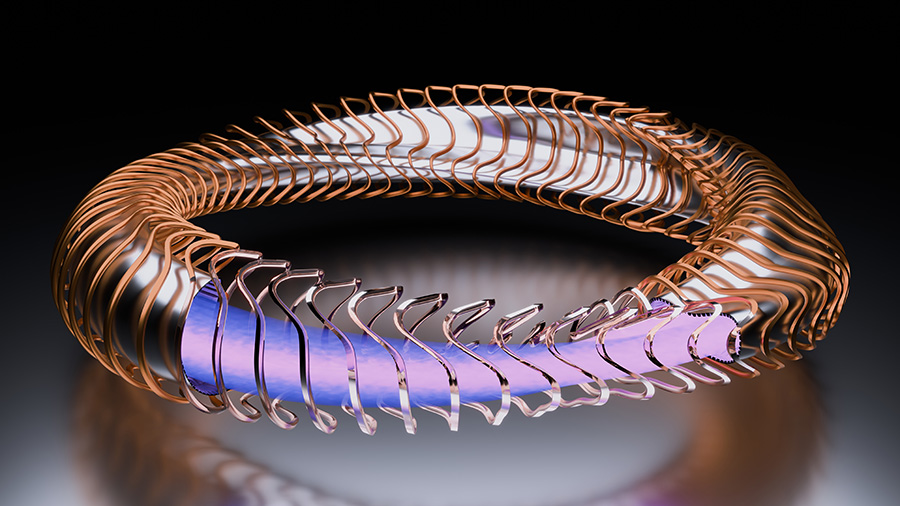
A conceptual stellarator with a partial cutaway showing the plasma region and surrounding magnetic coils.
In a paper published this summer in Physical Review Letters and recognized as the “Editor’s Choice,” Kaptanoglu and collaborators from the Max Planck Institute for Plasma Physics and NYU's Courant Institute of Mathematical Sciences describe a new way to design stellarator magnets. Their method produced designs that were easier to build or more accurate than previously published designs. It also runs on a single laptop. The work could help move stellarators closer to commercial fusion power plants.
Kaptanoglu joins A&A faculty members Uri Shumlak and Bhuvana Srinivasan in the department's fusion research. His work on stellarators adds a new type of fusion device to the group, and his background in applied math and machine learning adds new tools for designing fusion systems and making sense of complex plasma data.
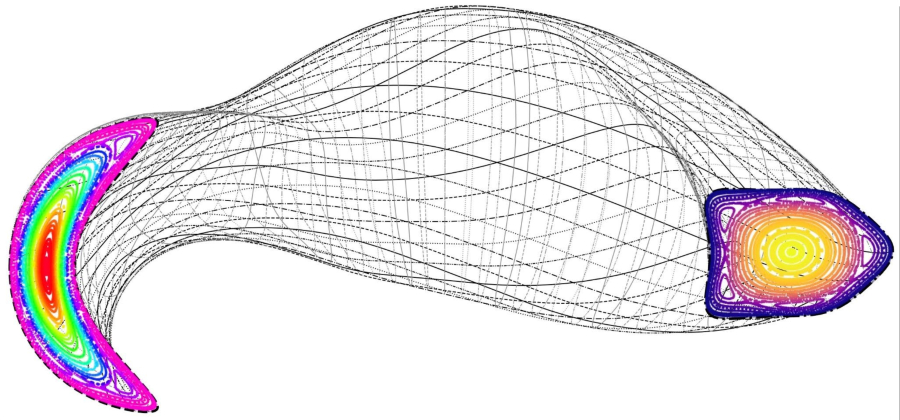
New results from Kaptanoglu’s group’s MRX code for calculating complex magnetic fields in three-dimensional toroidal geometry.
Kaptanoglu plans to continue his work in magnetohydrodynamic theory, numerical methods and optimization tools for designing nuclear fusion reactors. His interests also extend to dynamical systems and machine learning, with applications across engineering.
“The students and researchers in my groups at NYU and UW are working on a diverse array of cool projects, from designing plasmas that exhibit chaos, to optimizing efficient magnets for fusion reactors," he says.
Before returning to Seattle, Kaptanoglu was an assistant professor of mathematics at NYU's Courant Institute from 2023-2026. He earned his B.S. in physics from Stanford University in 2016.
Go to the sources
- Stellarator coils for future fusion reactors via an augmented Lagrangian approach. Pedro F. Gil, Weiping Li, Julianne Stratton, Alan A. Kaptanoglu and Eve V. Stenson. Physical Review Letters 137, 065101 | Published Aug. 7, 2026. DOI: 10.1103/n7gk-922h
- MRX: A differentiable 3D MHD equilibrium solver without nested flux surfaces. Tobias Blickhan, Julianne Stratton and Alan A. Kaptanoglu. arXiv preprint 2510.26986 | Last updated Sept. 16, 2026 as of this publication date. DOI: 10.48550/arXiv.2510.26986