
June 30, 2026
Every spring, our seniors close out their time working on one hard challenge. This year's ten capstone teams took on questions with real stakes: how a drone finds its way when GPS cuts out, whether a small satellite can map tunnels beneath the Moon, how an underwater glider makes it home after losing a wing. Along the way, they logged long hours in the lab and the wind tunnel, built prototypes from scratch, and learned to explain their work. These awards recognize a few standouts, but every team earned its place in the field.
Technical excellence awards
Capstone Technical Excellence Award: 3D Wings "STAMPS" Team
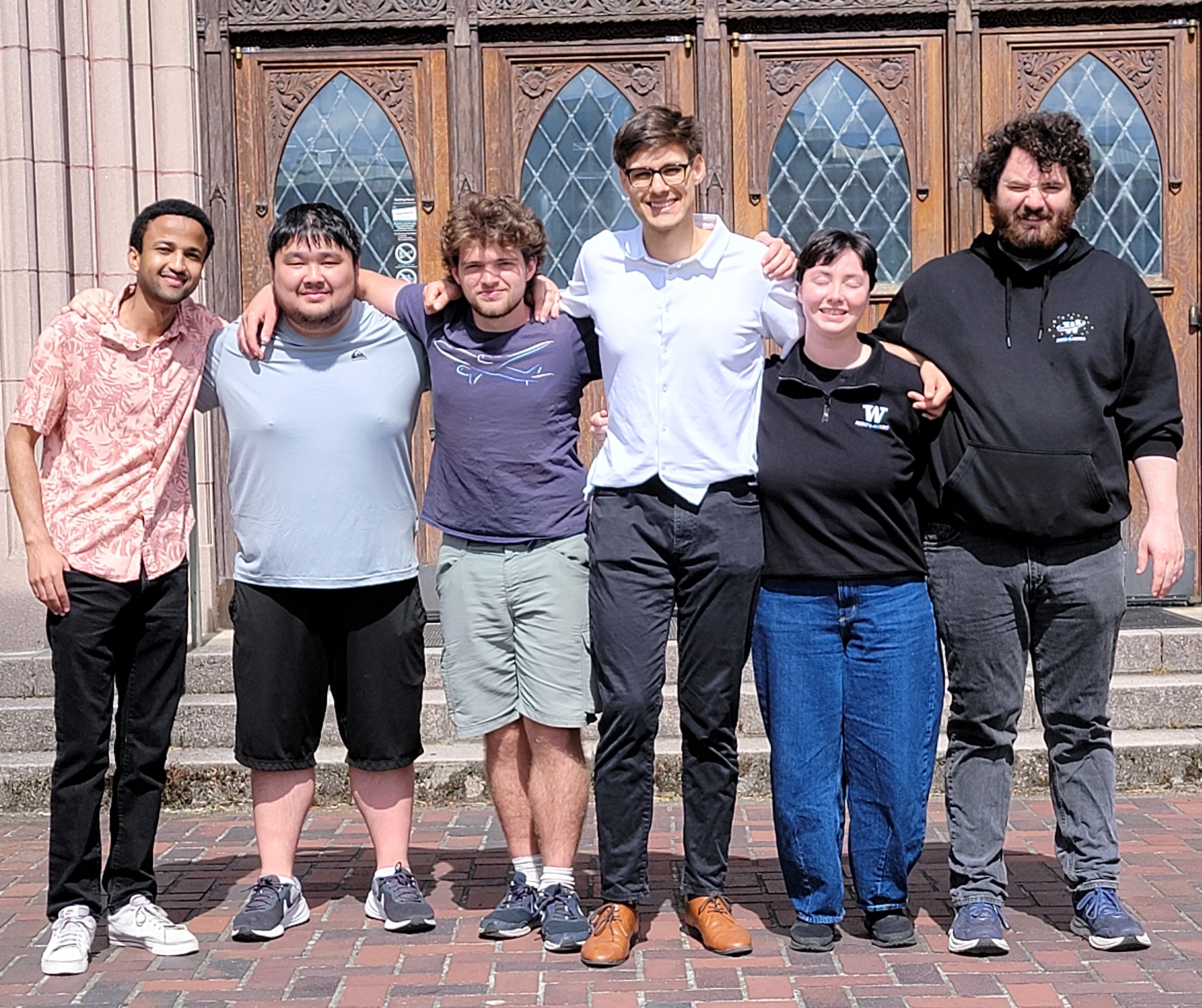
Yabets Onkiso, Harry Truong, Henry Rothschild, Hugh Suratgar, Kat Watson and Tyler Lawrence.
The STAMPS-Wing team (Stall Modes with Printed Sensors in Wing) tackled two projects at once: building a sensor to detect stall cells, zones where a wing loses lift, and using it to test an open hypothesis about how those zones move across swept wings. They logged more wind tunnel time than all other senior design teams combined, collecting over two billion data points. Their well-earned "inconclusive" conclusion reflects a team that took the science seriously enough not to oversimplify it.
Congratulations to team members Tyler Lawrence, Yabets Onkiso, Henry Rothschild, Hugh Suratgar, Harry Truong, and Kat Watson and faculty sponsors Professors Owen Williams and Ed Habtour.
Capstone Innovation Award: Husky Satellite Lab's Ground Penetrating Radar Team
This team set out to answer whether a small satellite can use radio waves to find tunnels hidden beneath the moon's surface. With almost no existing research to lean on, they built a working prototype and test plan from the ground up, laying the foundation for the Husky Satellite Lab's mission for years to come.
Congratulations to team members Domenic Acosta, Thomas Almquist, Matthew Aylward, Walker Holmquist, Caitlin Lam, Alexander Lee, Nick Maffeo, Dennis Ngo, Adam Olsen, Allessandra Ortale, Dylan Stecklein, and Jeffery Zhang.
Film Festival winners showcase creative communications and technical skills
Beyond technical achievement, our students proved they could communicate complex engineering concepts with style and clarity. The annual Capstone Film Fest showcased all nine teams presenting their projects through engaging videos, with two teams earning special recognition from both peers and our judges panel.
Best in Show: SARP 2-Stage Rocket Team
While most student-built rockets use a single motor, this team is developing a two-stage rocket with a booster and a sustainer to reach altitudes a single stage can't. Their work lays a foundation for SARP’s future high-altitude vehicles.
Congratulations to team members Molly Chapman, Benjamin Dinh, Joshua Dreistadt, Dale Gradwell, Anthony Rodrigo Guinto, Forest Lin, Jonah Lin, Tim Nguyen, Drew Rivers, Anthony Zhang and mentor Doug Chappelle.
People’s Choice: Seaglider Team
The Seaglider team built a digital twin of an underwater drone UW uses for ocean research. Deployed for months at a time, these drones can sustain damage, a lost wing or rudder, that puts the mission at risk. The team's digital twin system helps operators spot damage early and bring the vehicle home safely.
Congratulations to team members Jordan Cummings, Henry Hong, Holland Kantner, Letizia Laura, Edward Park, Oleksiy Polyakov, Geenadie Rathnayake, Josh Rolfe, Mak Sukimoto, Dante Weerasooriya, Kyle Wittcoff and mentors Professor Kristi Morgansen and Rick Rupan.
2026 Capstone Film Fest on YouTube
Our annual celebration of our capstone teams with 3-min shorts!
Where innovation meets impact
The award winners emerged from an exceptional field of ten teams, each addressing critical challenges in aerospace engineering. The remaining six teams also delivered impressive solutions that demonstrate the breadth and ambition of this year's capstone program.
ANPC: The "GPS Backup" for Drones
GPS can be blocked by tall buildings or jammed by bad actors, leaving drones that deliver packages or perform search-and-rescue without a reliable path. This team integrated a transponder-based triangulation system (TLS) into drone navigation. The technology works by sending signals to nearby transponders and calculating the drone's position based on how long each response takes to arrive.
ÆXOS Manufacturing: Robotic Legos in Space
Autonomous assembly will build structures in space, a job that is too difficult for humans to do. This team developed hexagonal tiles that locate each other and lock together on their own.
Boeing: Designing the 2030 Commuter Jet
Airlines are looking to replace aging regional jets with more efficient, right-sized aircraft. This team designed a next-generation single-aisle plane capable of carrying 110–120 passengers while burning significantly less fuel.
General Dynamics: The Self-Guided Payload
Today, as GPS availability is threatened worldwide, we look back to a time before satellite navigation became the norm. This team built a compact and adaptable system that determines position using inertial sensors alone, with no satellite input.
Radian: Supporting the World's First Spaceplane
The Radian One is a reusable vehicle designed to fly directly to orbit, but its weight and takeoff speed place extreme stress on its wings. This team designed the ground transport sled and wing-protection system that keeps the aircraft structurally sound from hangar to Mach 0.7.
SARP Engine: The Rapid-Fire Rocket Test Stand
Testing a new rocket injector design is slow and expensive, limiting how many ideas student engineers can explore. This team built a reusable test stand that cuts turnaround time substantially and supports rapid iteration.
Congratulations to all our capstone teams for a year of exceptional work and thank you to Professor Alvar Saenz Otero for all of his work with these teams.