
Amy Sprague
February 17, 2026
Samuel Buckner's work on perception-aware rocket guidance wins the 2026 Best Paper Award in the AIAA Guidance, Navigation, and Control (GNC) Graduate Student Paper Competition. This award marks the second year in a row that doctoral students in A&A’s Autonomous Controls Lab clinched the award, following Skye Mceowan in 2025.
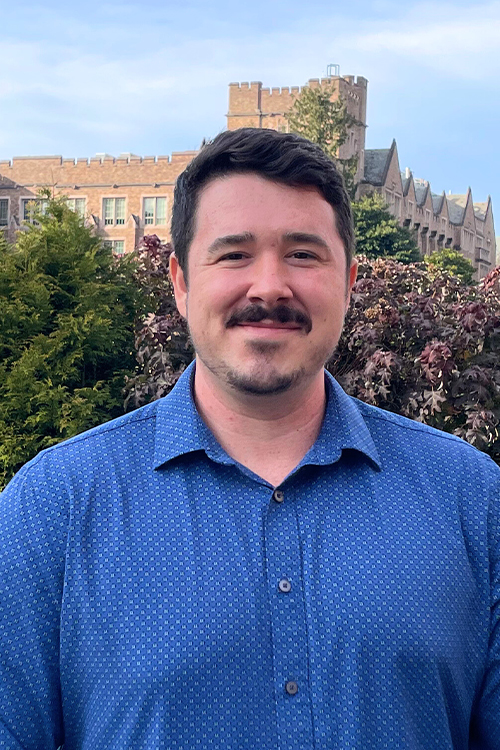
Samuel Buckner
When a spacecraft attempts to land on the Moon or Mars, it needs to safely navigate to a precise landing site while simultaneously building an accurate map of unfamiliar terrain.
Buckner, an National Science Foundation and ARCS Fellow, has developed a solution that could make autonomous landings safer and more reliable. His research paper, "Active Continuous-Time Simultaneous Localization & Mapping for Powered Descent Guidance Maneuvers," responds to these dual, but related, goals.
The paper, co-authored with Professor Behçet Açıkmeşe and NASA colleagues John M. Carson III and Breanna J. Johnson, introduces ACT-SLAM (Active Continuous-Time Simultaneous Localization & Mapping), a computational framework that coordinates a spacecraft's guidance and navigation systems during the critical final phase of landing.
A new approach to an old problem
Traditionally, aerospace engineers have designed guidance systems (which plan the vehicle's path) and navigation systems (which estimate the vehicle's position) as separate components. Buckner's research demonstrates how integrating these functions can produce better outcomes than optimizing them independently.
"The problem of co-design concerns efforts to jointly optimize objectives, or satisfy requirements, for several of these elements simultaneously," says Buckner. “For powered descent guidance scenarios, where spacecraft must satisfy strict physical constraints while managing uncertainty about their position and the surrounding terrain, this integrated approach offers meaningful advantages.”
The ACT-SLAM framework uses sensor measurements from instruments like LiDAR to simultaneously reduce uncertainty about both the vehicle's position and the terrain map. Rather than passively accepting whatever measurements a predetermined flight path happens to provide, the system actively plans trajectories that gather the most useful information for reducing navigation uncertainty.
A simulation of a landing maneuver generated by ACT-SLAM. On the left, the onboard LiDAR sensor's field-of-view is depicted by a cone emitting from the lander, color coded by ground landmarks as they become visible. On the right, elements of the state estimator's covariance matrix (which measures uncertainty of both the lander's position and the landmarks' positions) are color-coded according to relative magnitude, with darker elements corresponding to higher uncertainty. As landmarks come in to field of view, elements on the diagonal of the matrix become brighter indicating an improved navigational solution, which is quantified by the information gain, ΔI(t), relative to the beginning of the maneuver.
Testing the approach
Buckner and his co-authors validated ACT-SLAM through detailed simulations of a lunar landing scenario at a south pole site, using realistic digital elevation maps and three modeled terrain landmarks. The system had to satisfy multiple constraints typical of spacecraft landings, including limits on thrust, vehicle orientation, and approach angle.
Compared to previous methods, ACT-SLAM achieved 29.1% better performance against passive perception approaches and 36.3% improvement over an information-aware technique called Info-PDG, as measured by an information-theoretic metric. Perhaps more significantly, ACT-SLAM was the only method among those tested that successfully maintained visibility of all three terrain landmarks during descent.
The research team conducted Monte Carlo analysis with 1,000 trials to verify the approach's robustness. The results showed that the system's predicted uncertainty boundaries were exceeded in only 1.1% of cases, demonstrating high reliability even when accounting for random variations in initial conditions and sensor noise.
A comparison between the passive perception baseline, info-PDG and ACT-SLAM for the same landing scenario.
Building on a foundation of excellence
This recognition continues a pattern of achievement in Professor Açıkmeşe's Autonomous Controls Lab. Last year, doctoral student Skye Mceowen received the same Best Paper Award at the 2025 SciTech Forum, making this the lab's second consecutive year earning this distinction.
While ACT-SLAM currently requires longer computational time than simpler approaches, Buckner notes this tradeoff may be worthwhile for missions where landing precision and safety are paramount. The framework is designed to work within the template of continuous-time optimal control problems, making it adaptable to various mission scenarios beyond lunar landings.
Professor Açıkmeşe notes the importance of Buckner’s research, "As we look toward sustained lunar operations and eventual Mars missions, the ability to land precisely in terrain that hasn't been fully mapped becomes increasingly important. Samuel's framework provides a rigorous way to balance the competing demands of safe navigation and efficient fuel use, which are critical constraints for real missions."
Looking ahead, the paper identifies several directions for future work, including analysis of complete entry, descent, and landing sequences with full sensor suites, and computational improvements that could enable real-time trajectory optimization, another aspect that the Autonomous Controls Lab excels in.
Go to the source
Active Continuous-Time Simultaneous Localization & Mapping for Powered Descent Guidance Maneuvers” by Samuel C. Buckner, John M. Carson, Breanna J. Johnson and Behcet Acikmese. Published Online: 8 Jan 2026.