
Amy Sprague
October 29, 2026
A&A researchers are combining plasma physics and control theory to tame fusion plasma.
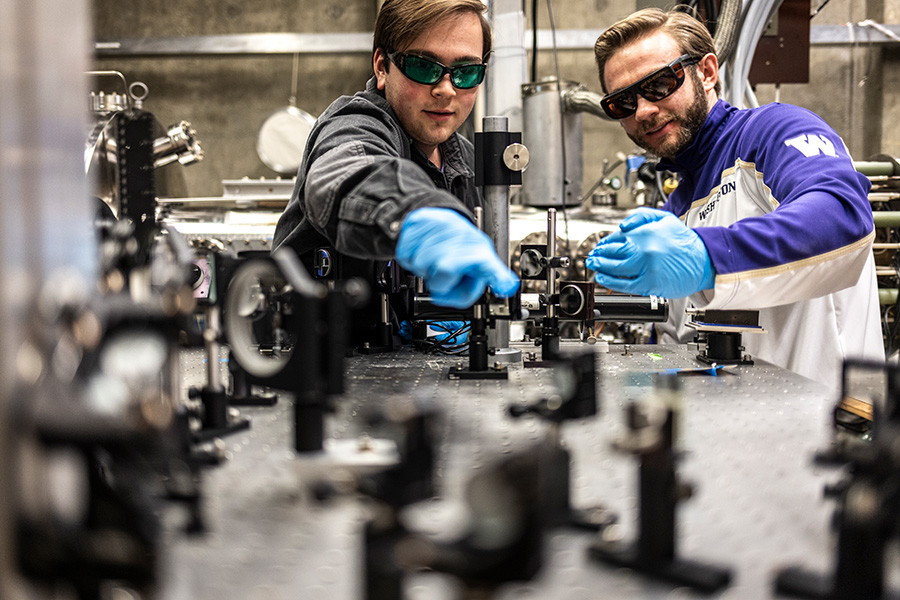
Shumlak's lab studies plasma confinement using Z-pinch devices. Here, two students are setting up a laser interferometer, which is used to measure plasma density.
Harvesting clean energy from fusion means holding a plasma at over 100 million degrees and extreme pressure without letting it touch the walls of its container. Often called the fourth state of matter, plasma forms when atoms get so hot that their electrons break free, leaving a mix of charged particles.
Researchers use strong magnetic fields to create a kind of virtual bottle for the plasma, or powerful lasers to squeeze it. But plasma doesn’t stay put easily. Tiny instabilities grow quickly, allowing heat and particles to escape. Keeping the plasma under control is one of the central challenges of fusion energy.
"A lot of fusion research is focused on managing instabilities in a plasma," says Professor Uri Shumlak. "That's really what makes fusion energy so difficult."
A new paper co-authored by Shumlak and a team of applied mathematicians shows how carefully tuned laser fields can hold some of these instabilities in check. The paper, "Control of kinetic plasma instabilities by laser fields," was selected as an Editor's Choice in Physics of Plasmas and featured in an AIP Scilight.
The work is also opening a new collaboration within the department, as Shumlak begins working with Assistant Professor Amir Taghvaei and the department’s controls group to apply control theory to fusion research.
Balancing a pen and calming fussy plasma
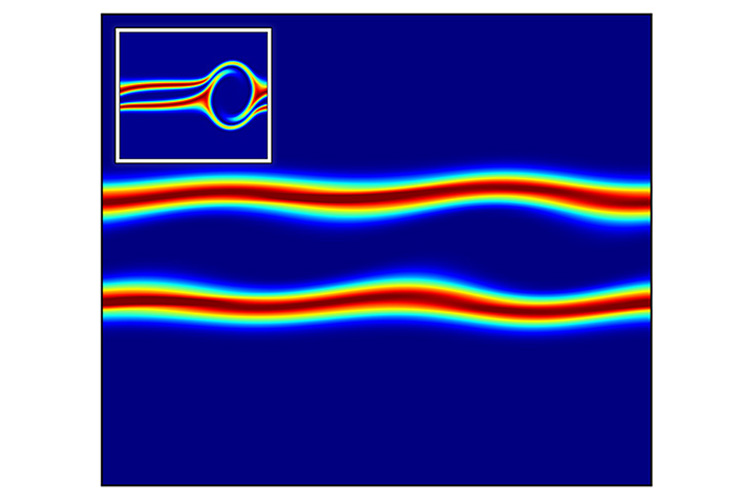
Two particle streams in a computer simulation. Without the laser control, they churn into a swirl (inset). With the laser control, they stay nearly smooth, even though the lasers can't calm this disturbance directly.
Plasma theorists have spent decades studying when and why instabilities occur. Shumlak and his collaborators wanted to know whether they could actively control those instabilities by shaping the electromagnetic fields acting on the plasma.
Earlier studies often assumed researchers could shape the fields inside a plasma however they wanted. That is not always possible in a real system, so this team added a real-world constraint. Working in theory and simulation, they asked what could be done with just two laser beams pointed at each other, adjusting the wavelength, phase, and polarization of the light to influence the plasma at a microscopic level.
The team found two ways the lasers could help. Some instabilities responded to direct control, where the laser fields push back against the plasma's fluctuations. Shumlak compares this to balancing a pen upright on your hand by shifting your hand underneath it.
But other instabilities couldn't be controlled directly. For those, the team found a workaround. By acting on one instability, they could slow the growth of another. Shumlak likens it to calming a fussy baby by singing or offering a binky. You're not addressing the fussing head-on, but giving the baby something else to focus on still does the trick.
"That was something that was really surprising," he says.
How the lasers calm plasma
Plasmas can become unstable in more than one direction. Some instabilities grow across the path particles are taking. Others grow along that path.
The team found that the lasers could directly calm the first kind of instability, but not the second. By changing how the first instability behaved, however, the lasers could slow the second one indirectly. In other words, the lasers did not have to control every disturbance head-on. They could calm one part of the plasma and, through its connection to another part, reduce a second disturbance.
Using computer simulations and a mathematical stability test, the researchers identified laser settings that delayed the growth of these instabilities.
Bridging aerospace controls and fusion physics
In aerospace, our control systems usually react faster than the vehicle moves. Plasma is the opposite: it changes faster than we can sense and respond.
Amir Taghvaei
Assistant Professor
This first study uses what researchers call open-loop control. The laser settings are planned in advance based on how the plasma is expected to behave.
A working fusion device would need closed-loop feedback control. In that system, sensors would measure what the plasma is doing, and a controller would adjust the laser fields in real time.
That's where the department's strengths in both plasma physics and controls come together. Aircraft and spacecraft use control systems to remain stable and follow a desired path. Those systems often rely on two key tools: estimating what is happening inside a complex system and adjusting its behavior in response.
Similar tools could help manage the turbulent environment inside a fusion device. Shumlak is beginning work with Taghvaei and other colleagues in the department’s controls group to explore how those methods could be applied to plasma.
"In aerospace, our control systems usually react faster than the vehicle moves. Plasma is the opposite: it changes faster than we can sense and respond,” says Assistant Professor Amir Taghvaei.
That mismatch shapes how the team has to approach the problem. Researchers must estimate what the plasma is doing from noisy sensors, plan using simplified models that are never perfect, and make sure the control stays robust to that uncertainty.
“Feedback can correct for model errors, but right now we can’t compute those corrections fast enough to keep up with the plasma,” Taghvaei says. “Closing that gap will take new advances in physics-informed estimation and control."
Shumlak is clear that there's a long road ahead.
"We haven't completely solved the problem yet," he says. "But this provides a path that allows us to think about how we can apply control algorithms to stabilize the plasma and keep it confined while the fusion burn happens."