
Amy Sprague
October 16, 2026
Alumnus Gary Lai and his wife, Natalya Yudkovsky, have established the Lai & Yudkovsky Term Faculty Fellowship to support faculty research in space exploration. Professor Uri Shumlak is its first recipient.
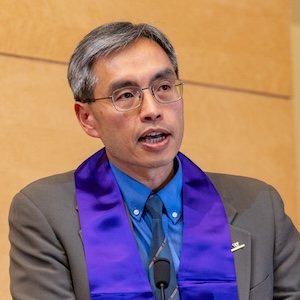
Gary Lai speaking at the 2025 A&A graduation
Lai earned his bachelor of science degree from our department in 1998, and Yudkovsky earned her Ph.D. in molecular and cellular biology from the UW in 2001. Lai brings over 25 years of transformative experience in commercial space technology. He joined Blue Origin as its 18th employee, rose to chief architect and led development of New Shepard, the company’s reusable suborbital vehicle. That work contributed to Blue Origin receiving the prestigious 2016 Collier Trophy, one of aviation's highest honors. In 2022, Lai experienced spaceflight firsthand as a crew member aboard New Shepard. Today, he’s co-founder and chief technology officer of Interlune, where he’s developing sustainable ways to harvest resources from the Moon. We named him our 2025 A&A Distinguished Alum.
The fellowship is intentionally flexible, and Shumlak says that’s what makes it so valuable.
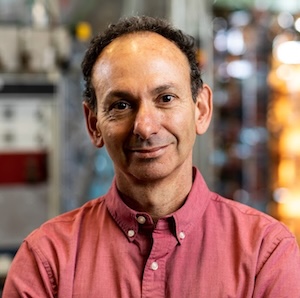
Uri Shumlak
“It’s not tied to a specific project where we’ve already proposed the work and committed to delivering it,” he says. “Because it’s flexible, it lets us do more exploratory, foundational research. I have a few ideas that aren’t developed enough yet to support a full proposal. This funding will let us explore them and generate that foundational data. From there, we can assemble a proposal for further funding.”
Shumlak studies plasma physics and Z-pinch technology, which have potential applications in future space propulsion and in energy production here on Earth. He plans to use the fellowship to support graduate students, equipment, fabrication and materials.
One promising direction extends work by former student Aqil Khairi (Ph.D. ‘25), who investigated plasma-material interactions at the cathode of a Z-pinch fusion device. Shumlak says the results were a surprise.
“You’ve got this super high-temperature plasma, at temperatures comparable to some of the hottest plasmas in the solar system, right up against a solid graphite surface that’s at room temperature,” he says. “The heat fluxes are enormous, so you’d expect the material to just erode away. But what Aqil found is that a recycling process develops. Particles come off the surface, get ionized, and are attracted back toward the surface. The surface self-heals.”
Now Shumlak wants to know how these processes differ at the other electrode, the anode. The anode is more difficult to study, so Shumlak says his team will need to develop some new techniques to investigate it. The results could have implications for a fusion space thruster.
Shumlak also hopes to explore direct energy conversion, a process that converts the kinetic energy of high-speed plasma plumes directly into electricity and could offer new possibilities for space propulsion and energy conversion.
Lai’s path to space started in our department. We’re grateful to him and Yudkovsky for helping the next wave of influential ideas get off the ground.