
Amy Sprague
October 15, 2026
A coin-sized vibration motor, the same kind that buzzes in your phone, can take apart a structure built from many 3D-printed pieces, one piece at a time and in an order you choose ahead of time. Assistant Professor Martin Nisser is a co-author on the new research that will advance structure assembly and disassembly in space.

Martin Nisser
Nisser's Programmable Matter Lab works on building large structures, especially for space. That work runs into a basic problem.
"If you want to build a large structure in space, you have this bottleneck where you have to fit all your parts into a rocket," he says.
Engineers get around that by folding things up, like the James Webb Space Telescope, or by sending up parts and putting them together in orbit. When those parts need to connect or disconnect on their own, each one usually needs its own actuator. While Nisser has worked on self-assembling and disassembly with electromagnets, this research focuses on the disassembly of structures through another method.
"The question we had was, can you assemble, or in this case disassemble, a very large structure with many, many parts using just a single actuator?" he says.
It's all in the shape
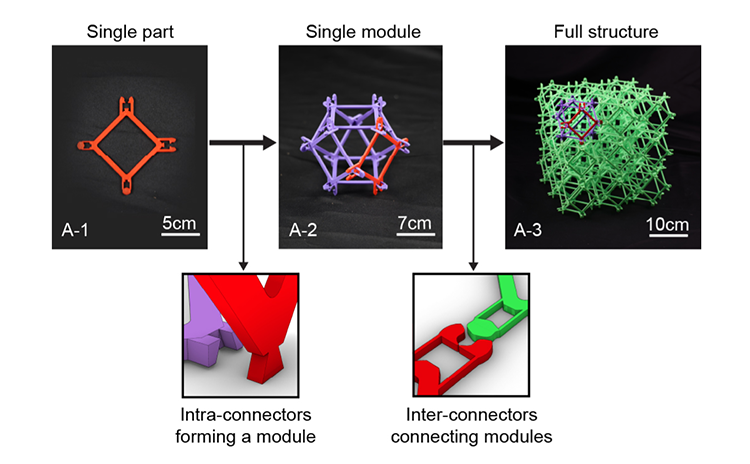
A single 3D-printed part becomes a module, and modules combine into a full structure. Intra-connectors (red) hold each module together, while inter-connectors (green) link modules to each other and release when triggered by vibration.
The structure is made of repeating modules, and it uses two kinds of connectors.
Each module starts as flat 3D-printed pieces joined by intra-connectors, joints that hold a single module together. They're designed to snap into place and stay put, even when the motor is running.
Modules link to each other through inter-connectors. On each one, a rounded tip slides between two flexible arms that squeeze to hold it in place. These are the joints designed to let go.
When the motor runs, vibration travels through the whole structure. Each inter-connector is designed to release at its own vibration level. Once the vibration reaches that level, the arms let go and push the two modules apart.
What decides when a connector lets go isn't the material. Every piece is printed from the same plastic.
"It's the shape," Nisser says.
By changing the shape of the inter-connector, the team can set how much vibration it takes to release and how far the modules spring apart. Turn the motor up little by little, and the pieces come off in order, no matter where they sit in the structure.
Watch a single vibration motor shake a 3D-printed structure apart, piece by piece and in a pre-set order — a technique Assistant Professor Martin Nisser's team is developing to simplify disassembly in space.
Smart structures, no electronics
For Nisser, the project fits into a bigger idea of mechanical intelligence.
"Can you make structures that have physical responses tailored to specific inputs, without any computing or electronics?" he says.
Without wiring or electronics inside, the modules are simpler and cheaper to make, and there's less that can break. That matters in places like orbit or the deep sea, where no one can easily step in to fix things.
Next, the team wants to trigger connectors with different vibration frequencies and better understand how vibration moves through large structures.