
October 13, 2026
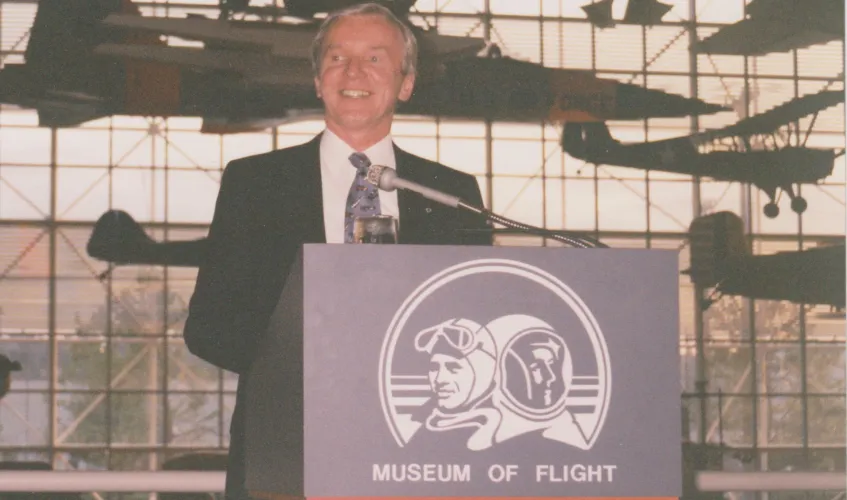
Walter Christiansen, professor emeritus and former chair of our department, died Sept. 23, 2026. He was 91.
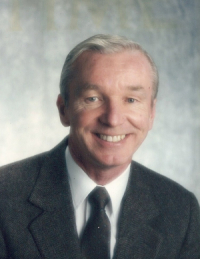
Walter Christiansen
Christiansen spent more than three decades in the department as a researcher, teacher and leader. He served as chair from 1992 to 1998, guiding A&A through one of the harder stretches in our history.
Christiansen earned a bachelor's degree in mechanical engineering from the Carnegie Institute of Technology (now Carnegie Mellon) in 1956, then a master's (1957) and doctorate (1961) in aeronautical engineering from Caltech under Professor Anatol Roshko. He had joined the U.S. Army Reserves as an ROTC student, and after Caltech he completed basic training and spent six years at NASA's Jet Propulsion Laboratory (JPL). His work there focused on rarefied gas flows and nonequilibrium plasmas.
In 1967, Abraham Hertzberg was building the UW's new Aerospace Research Laboratory (ARL), a multidisciplinary research program that would soon have its own building next to Guggenheim Hall. Among his first hires were Christiansen and his JPL colleague David Russell, both of whom would go on to chair the department.
"Walter's career paralleled mine in some remarkable ways," said Professor Emeritus David Russell, who preceded Christiansen as chair. "From our Caltech studies with the same advisor through our years at JPL and the University of Washington, our professional lives were closely intertwined."
ARL's labs were windowless by design, since so much of the work inside centered on gas-dynamic and chemical lasers and other optical research. That suited Christiansen. His research focused on gas optics, the interaction between fluid flow and light, and on using laser light as a diagnostic tool for fluid mechanics, with applications in skin friction measurement and holography. He also kept a long-standing interest in high-speed and hypersonic flow, exploring how short-duration facilities like shock tunnels and Ludwieg tubes could be used to test modern aircraft under full flight conditions. His work drew support from NASA, the Office of Naval Research and the Air Force Office of Scientific Research.
Christiansen succeeded Russell as chair in 1992 at a challenging time for the department. In the early 1990s, Boeing moved its low-speed wind tunnel testing elsewhere in search of higher Reynolds numbers, leaving the Kirsten Wind Tunnel, operated by the University of Washington Aeronautical Laboratory (UWAL), without its biggest source of income. Staff were transferred or retired, only a handful of student tests ran in 1993 and 1994, and a "Last Wind" party marked what many expected to be the tunnel's closing.
But the tunnel remained open. Operations were restructured to run with more automation and a leaner staff, and within a decade the facility was operating at more than 80 percent customer utilization, with Boeing once again among its clients.
The department grew in new directions during those years, too. When the UW's Nuclear Engineering Department dissolved in the early 1990s, plasma researchers joined the department, and their work on magnetic confinement fusion continues today. Later in the decade, a faculty team working with Insitu launched a research program in uncrewed aircraft. In August 1998, their small aircraft Laima flew from Newfoundland to Scotland's Benbecula Island in just under 27 hours, the first transatlantic crossing by an uncrewed aircraft of any size. And in 1997, the department introduced AA 101, Introduction to Air and Space Vehicles, a hands-on course for non-engineering students that quickly became popular across campus.
"Walter, together with Abe Hertzberg and Dave Russell, formed the bedrock of ARL for many years," said Professor Emeritus Adam Bruckner, who succeeded Christiansen as chair. "Their research in gas dynamics and lasers is what drew me to join the group in the early 1970s. Walter became a valued colleague, and his leadership proved invaluable to the department."
Christiansen was named a Fellow of the American Institute of Aeronautics and Astronautics and was a member of the American Physical Society. After 34 years in the department, he retired but kept teaching for another four years.
Over the decades, Russell said, the two became close friends. "We climbed mountains, sailed together and shared a love of the outdoors, while our wives developed a close friendship of their own," he said. "Walter was a thoughtful, intelligent man, and I was fortunate to have him as both a colleague and a friend for so many years."