
Amy Sprague
September 30, 2026
A&A senior Mark Platonov has been named a 2026 Astronaut Scholar, joining a class of 79 scholars from 54 universities across the country.
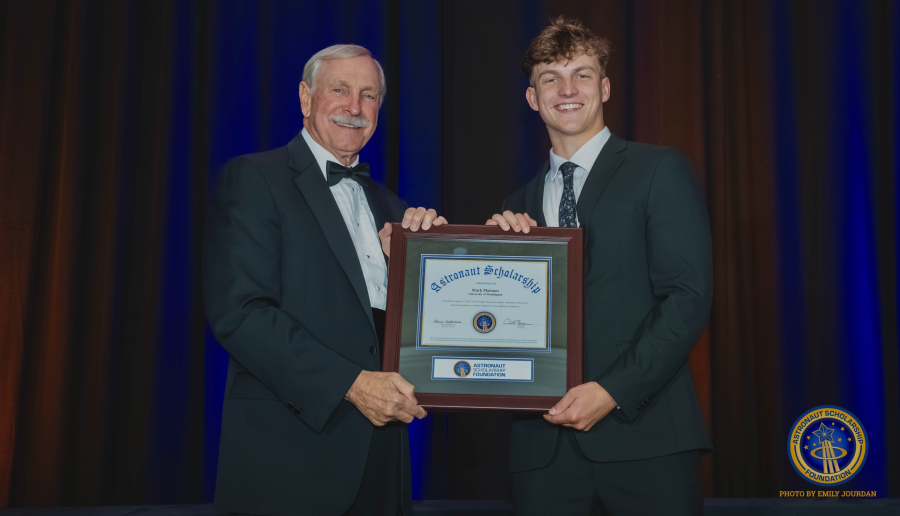
“Receiving the Astronaut Scholarship is a tremendous honor, and I’m very grateful to everyone who made it possible, including Assistant Professor Charles Dorn, the A&A faculty, my peers, industry mentors, and many more,” he says.
The Mercury 7 astronauts who were still living in 1984 created the Astronaut Scholarship Foundation to help keep the United States at the forefront of science and technology. Today, the foundation supports juniors and seniors in STEM who plan to go on to research or advance their field. Scholars receive up to $15,000, mentoring and networking with astronauts, alumni and industry leaders, and a paid trip to the foundation’s Innovators Symposium & Gala.
In August, Platonov traveled to Houston for the symposium. He presented his research there and received his award from retired NASA astronaut Col. Curtis Brown. Brown flew six Space Shuttle missions and commanded three of them, including STS-95, the mission that returned John Glenn to space. More than 20 astronauts attended the event.
“It was intimidating to present my work, but equally motivating,” Platonov says. “Seeing the important problems undergraduate STEM students from across the country are tackling reinforced for me how important it is to expand access to research opportunities, so talented students from all backgrounds have the opportunity to contribute.”
Building intuition in a research lab
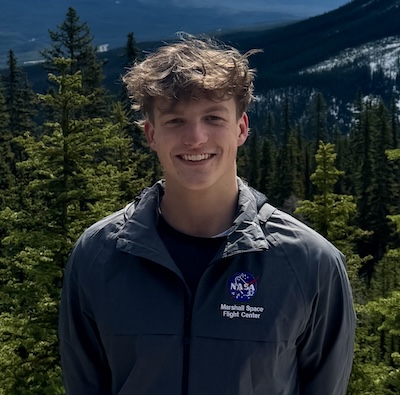
Mark Platonov
Platonov chose aerospace because he saw a field with plenty of room for meaningful problems to be solved. For nearly two years, he’s been working on those problems in the Dynamic Materials and Structures Lab, led by Dorn. His research focuses on detecting and characterizing damage in engineered materials, particularly metamaterials. Platonov’s research is also supported by the Mary Gates Research Scholarship.
“Working with Professor Dorn has been the single most transformative experience of my undergraduate education,” he says. “I owe him a great deal for his mentorship and for giving me the opportunity to work with substantial autonomy and creativity on open-ended research problems.”
This summer, Platonov took a damage-localization method that he previously developed and validated on simple metamaterial lattices and extended it to more complex geometries and a wider range of damage cases. The bigger goal is a method that can find damage in a material and also measure how severe it is, which could apply to structures operating in real-world conditions.
He says the technical skills matter, but learning how to approach unfamiliar problems and build intuition has mattered more. Working in a small lab has also given him the independence to develop and pursue his own ideas.
“Metamaterials are promising, but for high-stakes aerospace applications we need structural reliability guarantees,” says Dorn. “Mark’s research is building a foundation to make that possible, and he’s been a tremendous addition to our lab.”
Looking ahead
Platonov also spent part of his summer as a research intern at MIT Lincoln Laboratory, working on spacecraft navigation in degraded environments. This autumn, he’s continuing his research with Dorn while interning with the guidance, navigation, and controls team at SpaceX. After graduation, he plans to pursue a Ph.D. in aeronautical and astronautical engineering.
His advice for students applying for scholarships? Show your impact. Plenty of applicants have strong grades and research experience, he says. What can make a difference is showing how your work connects to something bigger than yourself.
The Astronaut Scholarship process is supported by the Office of Merit Scholarships, Fellowships & Awards (OMSFA), an Undergraduate Academic Affairs program. OMSFA works with faculty, staff and students to identify and support undergraduate students and alumni in developing the skills and personal insights necessary to become strong candidates for this and other prestigious awards. To learn more about applying for the Astronaut Scholarship, please visit this scholarship webpage.