
Amy Sprague
September 24, 2026
Samet Uzun sets up the math behind real-time autonomy.
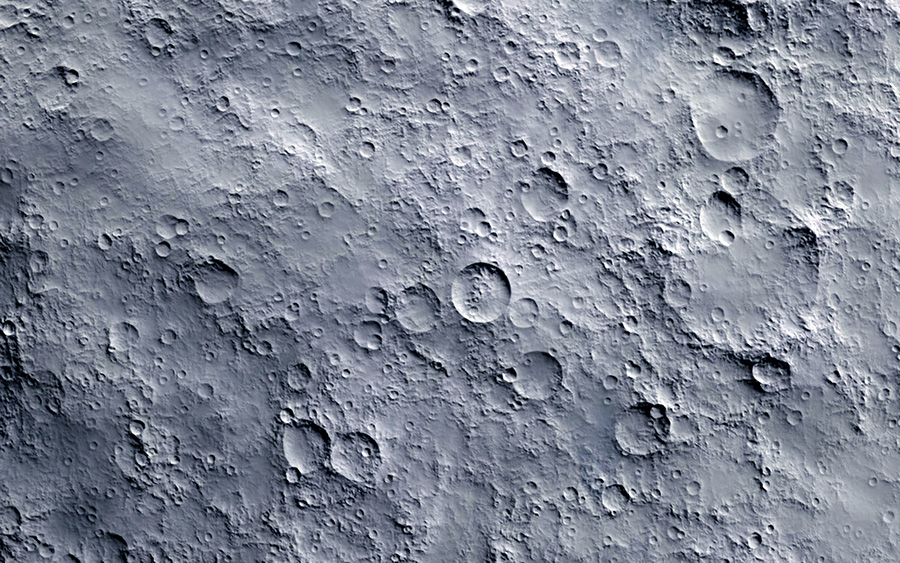
Samet Uzun's research will facilitate space landings on unknown terrain.
A rocket is descending. Below 100 meters, a cascade of requirements kicks in simultaneously: speed must drop below a threshold, tilt angle must stay within bounds, a camera must lock onto the landing site. The system has milliseconds to calculate a path that satisfies all of them at once.
For Boeing-Teslow Fellow Samet Uzun (Ph.D. ‘26), that scenario is a test case and a motivation. Working with Professor Behçet Açıkmeşe, Uzun has developed new mathematical methods that allow autonomous systems to handle complex, time-sensitive reasoning quickly enough to be useful.
The problem: The math is too complex to be fast
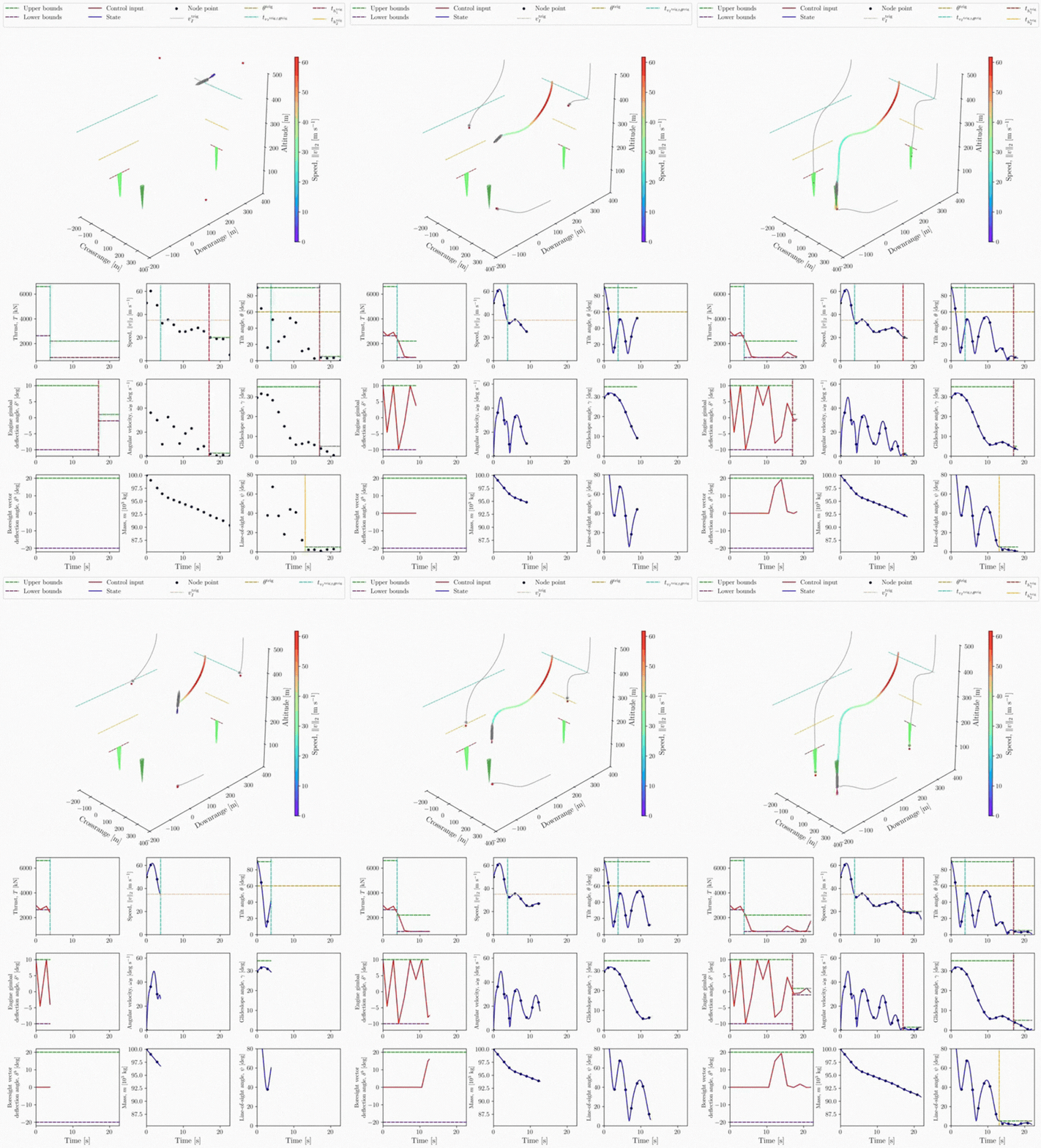
As the rocket descends, its constraints shift in real time. Speed and tilt bounds tighten, and the engine gimbal and thrust limits adjust the moment the vehicle crosses a trigger altitude, all part of the compound state-triggered guidance of Uzun’s method.
Trajectory planning, figuring out how a vehicle gets from point A to point B under a set of constraints, relies on optimization. Feed the problem to a solver, and it finds a path. But how fast a solver finds that path depends on the kind of problem it's given.
Continuous problems, where variables can take any value in a range, have efficient, well-developed solvers. Discrete problems, where a variable must land on one of a fixed set of values — for example, exactly 0 or exactly 1 — are far harder. As Uzun puts it, "If a variable should be somewhere between 0 and 1, that works nicely. But if I say it should be either 0 or 1, not in between, it becomes a much more complex mixed integer programming problem."
Mission requirements are full of these discrete conditions. Should the rocket tighten its speed, tilt, and line-of-sight requirements once it drops below a certain altitude? Should the drone stay below a speed limit until it reaches a charging station, or eventually inspect every target while satisfying its sensing constraints? Each “temporal logic” condition embedded in a mission plan can turn a fast, elegant problem into a combinatorial puzzle that takes a standard computer an hour to solve. For a system operating in real time, on a spacecraft or in a safety-critical vehicle, that's not an option.
The method: Convert complex requirements to smooth constraints
Samet Uzun
Uzun's core contribution is a modeling technique that transforms these discrete, hard-to-solve specifications into what he calls smooth and exact constraints.
Smooth, in the mathematical sense, means the problem has a structured, navigable landscape that efficient optimization solvers are built to handle. Exact means the transformation doesn't sacrifice accuracy. The solver searches through a smooth space, but the result only holds when it satisfies the original discrete requirement.
"We take the hard discrete problem, model it as something smooth that we can actually solve, and the solution is still valid for the original problem," Uzun says.
The technique works within a framework called "Signal Temporal Logic," which allows complex, time-sensitive mission requirements to be expressed precisely. A drone can be told to visit a charging station at any point during a 30-minute flight, not at a fixed moment, but eventually, depending on other factors and constraints. A rocket can automatically tighten its speed and tilt constraints the moment it drops below 100 meters. This is the conditional logic, the "IF," "EVENTUALLY," and "UNTIL" of a mission plan, that typically makes optimization hard.
Standard optimization is good at stacking requirements: satisfy this constraint, and then this one, and then this third one. Uzun's technique adds the "OR," giving a solver a way to handle choices and timing as well: visit the charging station now or later. Combining AND and OR opens up a much richer set of mission requirements, and Uzun's method lets a solver handle all of it as smooth, fast math.
Modeling the problem is half the challenge. Solving it is the other. To complement his modeling work, Uzun developed the Prox-convex algorithm, a sequential programming method that finds and exploits convex (a shape solvers can search efficiently) structure hidden inside non-convex problems. Even when a problem isn't convex overall, its component functions often contain convex parts, and the Prox-convex algorithm uses that inner structure to converge on a solution reliably and quickly.
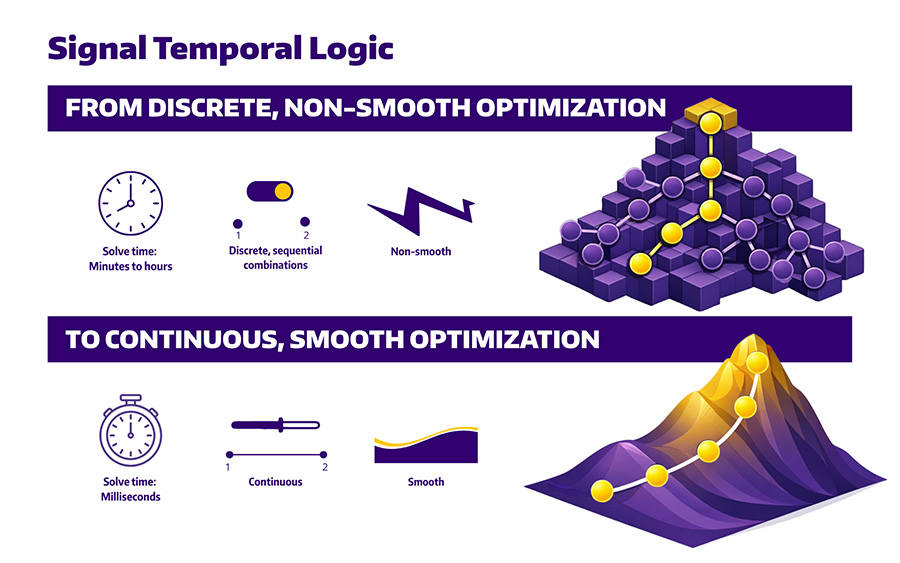
Samet Uzun’s modeling technique works within a “Signal Temporal Logic” framework to convert discrete decisions, or non-smooth problems, to a continuous, smooth format that a standard optimizer can solve much more quickly.
In practice: The smooth math does the work
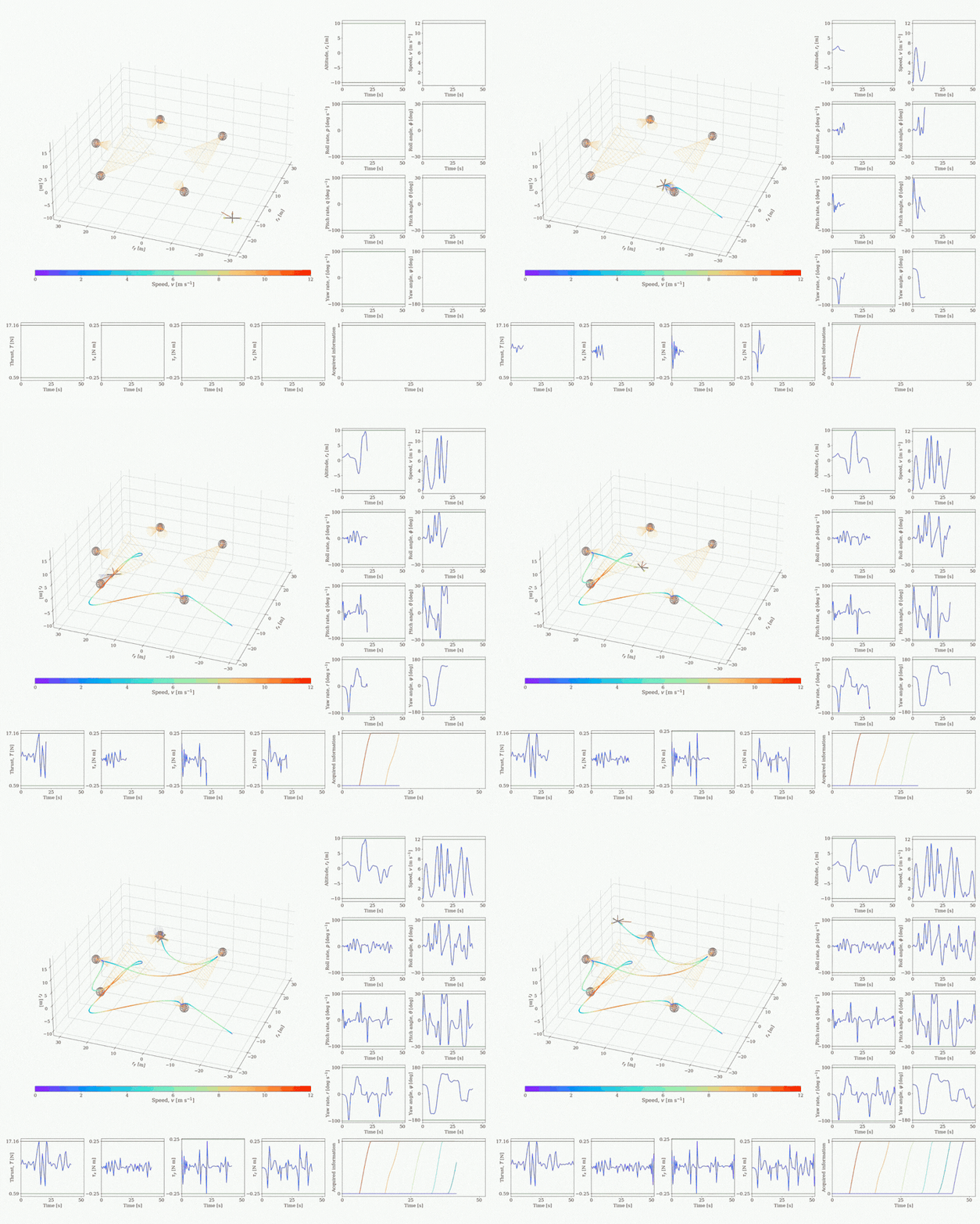
A simulation of route of a quadrotor solving multiple constraints. Uzun's solver finds the most efficient path quickly.
The sweep maneuver shows that Uzun's methods make it possible for autonomous systems to work through complex, layered requirements and find solutions on their own
"Nobody told the drone to do that," Professor Açıkmeşe says. "We gave it the constraints and let the solver figure out the rest. That it landed on a maneuver we wouldn't have thought to design ourselves tells you what Samet built here."
"I like that the math finds its own answer," Uzun says. "You set up the rules, and the solution comes out, often a better one than you would have guessed."
This test scenario, created during Uzun’s internship at Mitsubishi Electric Research Labs, is a quadrotor that must monitor a series of targets along a corridor. For each target, three constraints must be satisfied simultaneously: the drone must be within a certain distance, within the correct angular field of view, and pointing its camera directly at the target. It also needs to hold that position long enough to gather sufficient data.
To satisfy all of that at once, the optimizer produced a solution nobody explicitly designed. Rather than approaching each target head-on, the quadrotor first overshoots, then loops back in from behind, sweeping through the required angle to collect data before moving on to the next target. The maneuver is efficient, it satisfies every constraint, and it emerged entirely from the math.
The Boeing-Teslow Fellowship is supported by two sources. Boeing's fellowship supports graduate student education and research in the department. The James L. Teslow Endowed Fellowship supports Ph.D. candidates in the department whose work applies aerospace disciplines to space exploration.
Go to the sources
- Prox-Convex: A Proximal Method for Composite Optimization with Smooth and Convex Components. Samet Uzun, Dayou Luo, Behçet Açıkmeşe, Aleksandr Aravkin. December 2025, arXiv. Related figures on GitHub.
- Optimization with Temporal and Logical Specifications via Generalized Mean-based Smooth Robustness Measures. Samet Uzun, Purnanand Elango, Pierre-Loïc Garoche, Behçet Açıkmeşe. May 2024, arXiv. See also "Smooth and Exact Parameterization of Discrete-time Signal Temporal Logic Specifications" on GitHub.
- Successive Convexification for Trajectory Optimization with Continuous-time Satisfaction of Signal Temporal Logic Specifications. Samet Uzun, Behçet Açıkmeşe. June 2026, arXiv. See also "Trajectory Optimization with Continuous-time Satisfaction of Signal Temporal Logic Specifications" on GitHub.
- Sequential Convex Programming for 6-DoF Powered Descent Guidance With Continuous-time Compound State-Triggered Constraints. Samet Uzun, Behçet Açıkmeşe, John M. Carson III. September 2025, arXiv. Related figures on GitHub.
- Motion Planning for Information Acquisition via Continuous-time Successive Convexification. Samet Uzun, Behçet Açıkmeşe, Stefano Di Cairano. IEEE 2025.