
Amy Sprague
September 15, 2026
Vector algebra has carried alum Emmett Lalish (BS ‘05, MS ‘07, Ph.D. ‘09) from UAVs to 3D printing to an Oscar-winning blockbuster.
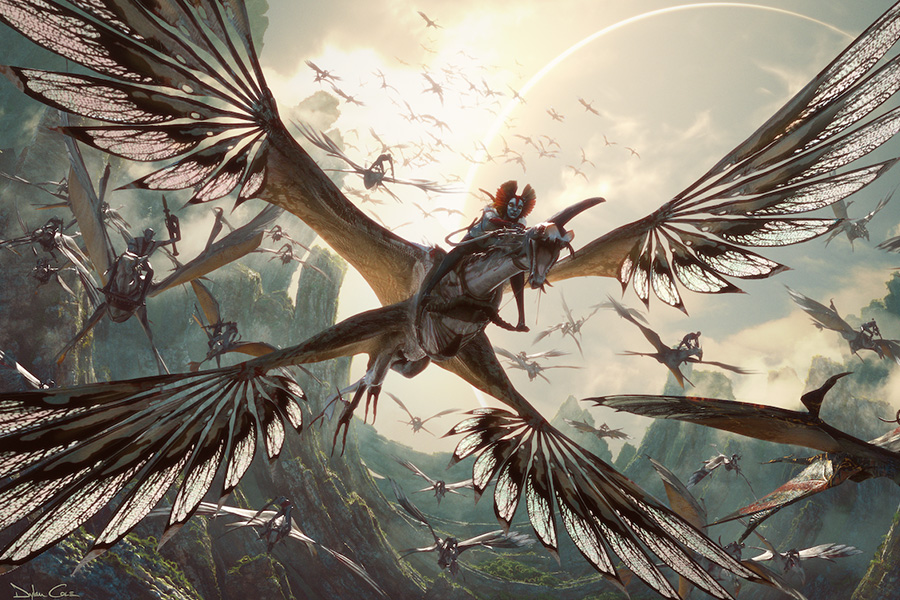
Emmett Lalish works on Mānuka, the Wētā FX renderer that produced every frame of "Avatar: Fire and Ash," including this one. Image: Disney, with permission for editorial use.
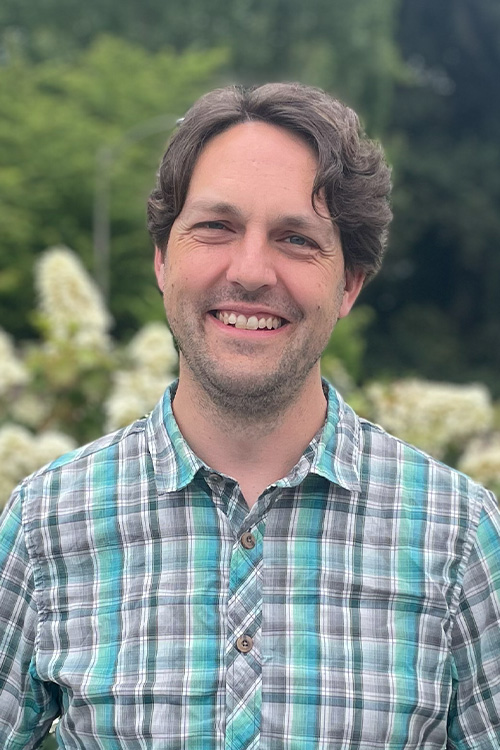
Emmett Lalish
Emmett Lalish (BS ‘05, MS ‘07, Ph.D. ‘09) has designed collision avoidance algorithms for uncrewed aerial vehicles (UAVs), built 3D printing software at Microsoft, run an open source graphics project used by IKEA and the Smithsonian, and helped render the exploding androids in the movie “Predator: Badlands.” The connection that winds through defense research, big tech, startups and blockbuster films, he says, is vector algebra.
"I think I found basically the only two industries that use quaternions," he says. "Orbital flight mechanics and graphics."
Lalish now works at Wētā FX in Wellington, New Zealand, on Mānuka, the studio’s renderer. It's the software that produces every pixel of every frame in films like “Kingdom of the Planet of the Apes” and the “Avatar” franchise. He ended up there following his curiosity where the math led, and he now shares in the studio’s 2026 Oscar for “Avatar: Fire and Ash.”
Keeping UAVs from colliding
Lalish moved fast from the start. He entered the University of Washington at 16 through the then-new Running Start program, transferred to A&A as an 18-year-old junior, stayed on for a master's and then completed a Ph.D. under adviser Professor Kristi Morgansen before he was 25.
His dissertation, “Distributed Reactive Collision Avoidance,” tackled the problem of keeping swarms of UAVs from hitting each other, which he framed as automated air traffic control. His approach reflected a practical streak that runs through his whole career. Other researchers were publishing proofs that guaranteed their robots would never collide. Lalish saw a flaw in that.
He says, "I know that if they're close enough together and going fast enough, there's nothing they can do to stop from colliding. So if you've guaranteed it globally, I know that your assumptions are not valid."
At the time, quadcopters were brand new, and the idea of skies full of UAVs needing automated deconfliction was speculative. As he puts it now, "That's kind of a thing now."
Building the first UW Design Build Fly team
Lalish's UW story is also the origin story of the department's Design Build Fly (DBF) team. In 2005, he and a group of classmates formed the first UW DBF team and traveled to the competition in Maryland, where their plane crashed on its first takeoff attempt. He still has the crushed motor mount.
The team went dormant after that founding group graduated, until Boeing approached the department with support to restart it during Lalish's grad school years. He led the revived team for the rest of his time at the UW.
The team had one advantage most competitors lacked: UWAL’s Kirsten Wind Tunnel. Because the test section was big enough for the actual competition aircraft, the team could bolt in their plane, servos and motor and all, and run control, power and propeller tests without opening the door between runs.
By his final year, the team placed in the top ten nationally.
The experience of leading, teaching and organizing a student team, he says, proved as valuable to his career as his research. "The fact that I had to learn how to motivate employees to work with non-financial incentives, that's something most companies struggle with. That's been hugely helpful in my open source projects."
Testing a variety of configurations of the 2007 UW Design Build Fly plane in UWAL’s Kirsten Wind Tunnel. Lalish was a founding member of the team and was leading it as a graduate student in 2007. In the 2009 competition, the team placed tenth.
A career in vectors
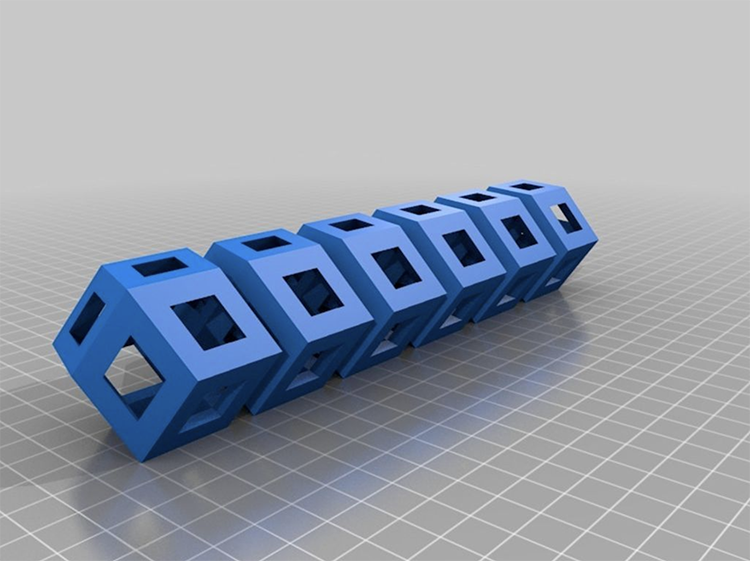
A rendering of a 3D-printed rhombic dodecahedra chain, one of many 3D printed designs that Lalish has created.
After his Ph.D., Lalish worked at a small DARPA contractor in Issaquah, then followed a 3D printing hobby to Microsoft, where he spent three years working on geometric algorithms as a program manager and discovered he genuinely enjoyed writing code. A volumetric video startup came next, where he taught himself C++, CUDA and OpenGL, followed by a brief stint writing control software for a pizza-making robot startup before he landed at Google.
There he found <model-viewer>, a small open source web component for displaying 3D objects on webpages. He ran the project for the rest of his six years at Google, and the tool spread across e-commerce, appearing on sites for Target and IKEA. Its homepage features a Smithsonian scan of Neil Armstrong's spacesuit, a model Lalish worked hard to secure the licensing for.
On his own time, he built Manifold, an open source geometry library born of frustration that basic CAD operations, like joining two shapes together, would randomly fail in software across the industry. He says, "When I want a computer to do something, I want it to do it right all the time."
A company of artists
A family trip to New Zealand changed everything again. Lalish left Google, networked his way to Wētā at SIGGRAPH, the graphics industry's main conference, and moved his family of five to Wellington.
At Wētā, he found something he felt tech companies were missing. His parents were artists, and he has always seen art and engineering as closely related. He says, "It's a company of artists, and they are all extremely technical. Every movie is doing something that no other movie has done before."
The work draws directly on his aerospace training, from the state estimation behind motion capture to the fluid dynamics behind fire and particle effects. One of his Wētā colleagues leading effects simulation is a fellow aerospace engineer. Lalish says, "It's basically Computational Fluid Dynamics, just done for effect instead of for numbers."
Advice? “Make something useful”
Lalish's advice to today's students draws on his DBF years and everything since. There's a lot to be said for making something and seeing how it fairs in the real world, he says. And he sees software as essential no matter where an engineering career leads.
"All roads lead to software engineering," he says. The more he has worked in it, the more he sees it as a discipline of communication. "Software is more like a novel. You're organizing your thoughts and making it readable by other people."
He predicts that writing code will come to be seen as a form of basic literacy. "How is it that anyone's getting out of high school without writing some code? It would be like not being able to read a newspaper."
Lalish practices what he preaches about making things. Before moving to New Zealand, he handed down his old RC planes to the current DBF team and gave them a talk, complete with photos from the original 2005 squad. He still follows the team from Wellington and has watched today's students surpass his teams' best finish.
"Their airplanes are incredible compared to the ones we were building," he says. "I'm thrilled that DBF has grown and is embraced by the department. It's really good to see."