
Amy Sprague
September 10, 2026
Assistant Professor Amir Taghvaei has won a Young Investigator Program award from the Air Force Office of Scientific Research (AFOSR YIP) to improve the algorithms behind navigation, tracking and forecasting so that they work even when engineers don't fully understand the system they're tracking.
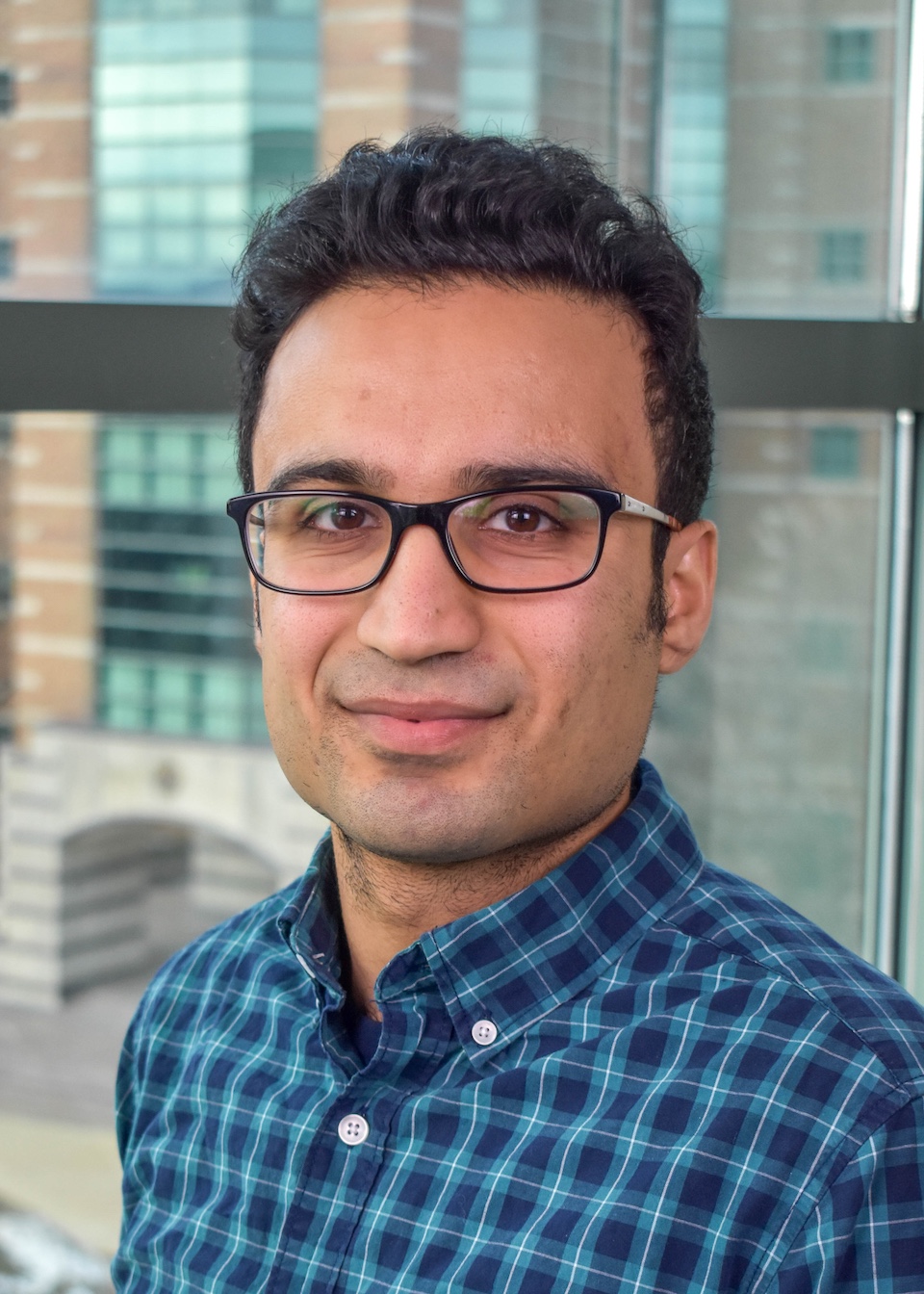
Amir Taghvaei
Those algorithms come from a field called nonlinear filtering. A filter takes a physical model of how something should behave, compares it against live sensor data, and corrects itself as it goes. It returns both an estimate and a measure of how much that estimate can be trusted, which is why filtering is still standard in aerospace and defense, where data are limited and an unexplained failure isn't acceptable, even as machine learning has taken over elsewhere.
"A language model can be trained on the whole internet, while in aerospace every data point can cost a test flight or a costly experiment," Taghvaei says. “On top of that, the model has to stay understandable to the engineers using it, and a wrong answer can be catastrophic.“
But filters have a well-known weakness. They assume the physical model they're given is correct. When a parameter is off or conditions shift mid-flight, a filter will keep reporting high confidence in estimates that are no longer accurate.

Nonlinear filtering as a foundation for prediction: Tracking a drone from noisy observations, a filter keeps both plausible futures, straight or turning, with the uncertainty in each. A black-box (non-filtered) model averages them into one prediction (red), placing the drone where it will almost certainly never be.
Taghvaei's approach is to stop treating the model as fixed. His project represents each possible model as a point in a space, so that any two models have a measurable distance between them. That makes it possible to ask how far the model in use is from the one the sensor data actually support, and to design filters that account for the gap instead of ignoring it. The mathematical tool for measuring those distances comes from optimal transport, an area his research group has been advancing.
The Young Investigator Program supports early-career researchers whose basic research is relevant to Air Force missions, with awards spanning three years.
"The fundamental nature of this research ensures impact for the Air Force by advancing core capabilities in autonomous decision-making, navigation, and control under uncertainty," he says. "The goal is to construct predictive models that are not only data-driven, but also adaptable, interpretable, and robust to uncertainty."