
Amy Sprague / Photos by Matt Hagen
July 22, 2026
Faculty earning national research honors. Student teams putting a satellite in orbit and reaching the podium against teams from a dozen countries. Seniors turning capstone projects into real solutions. Graduate students winning best paper awards across their subdisciplines.
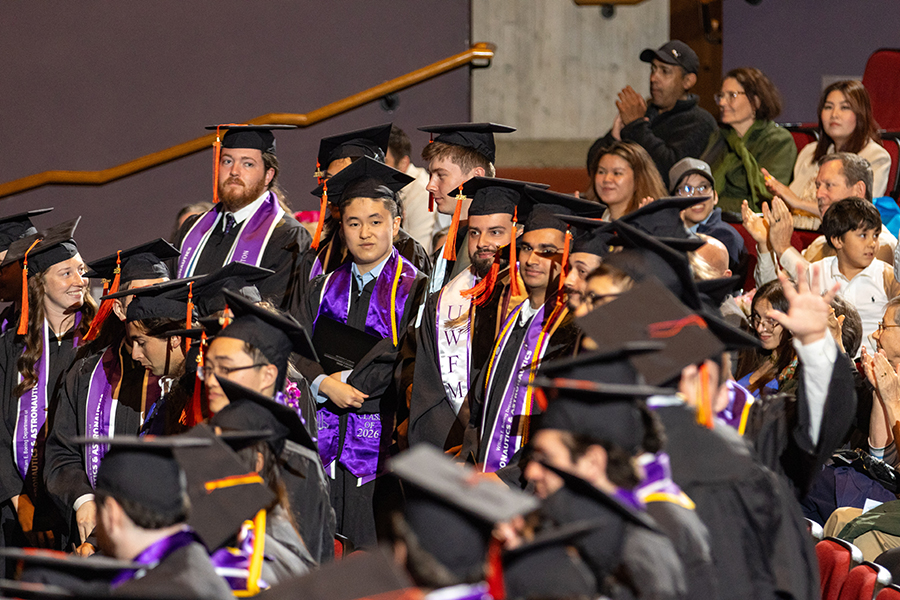
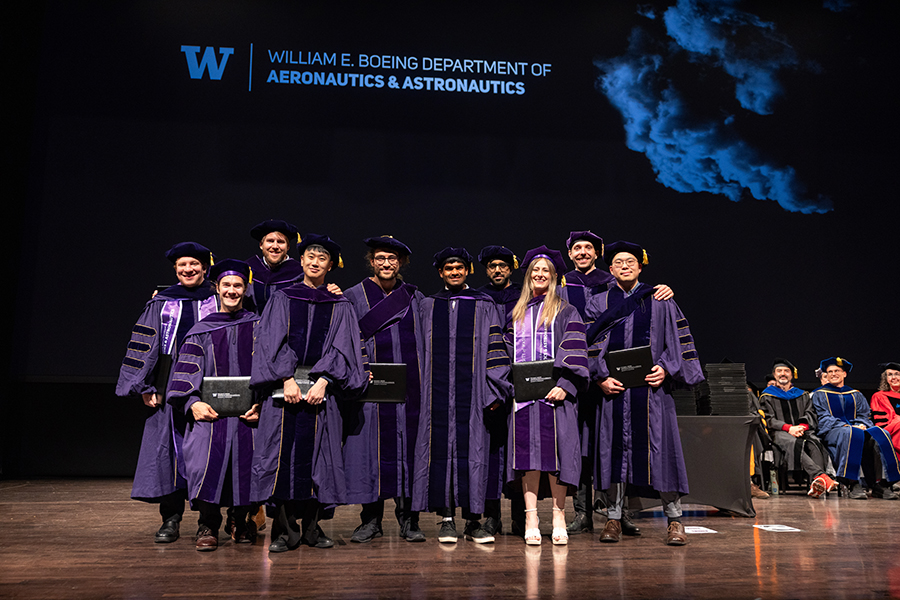
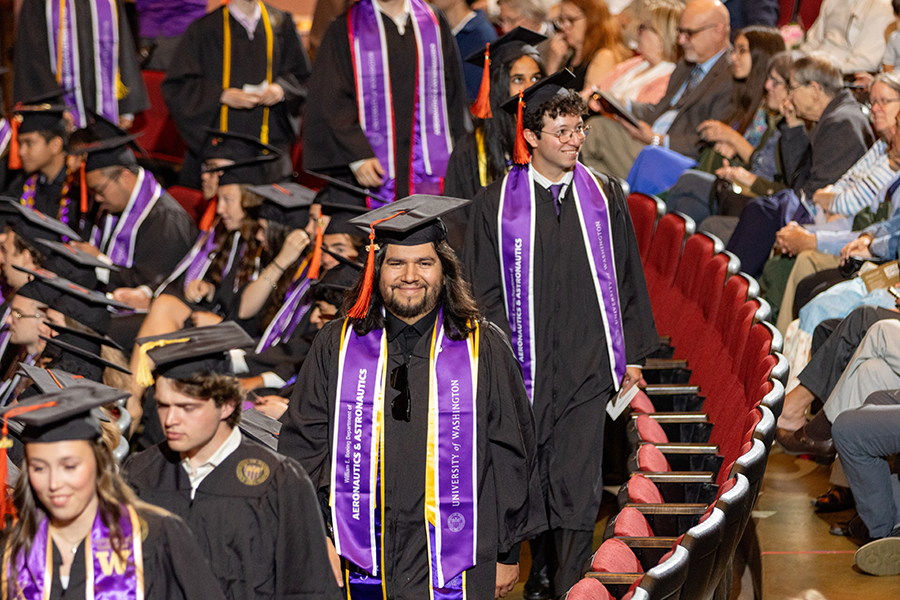
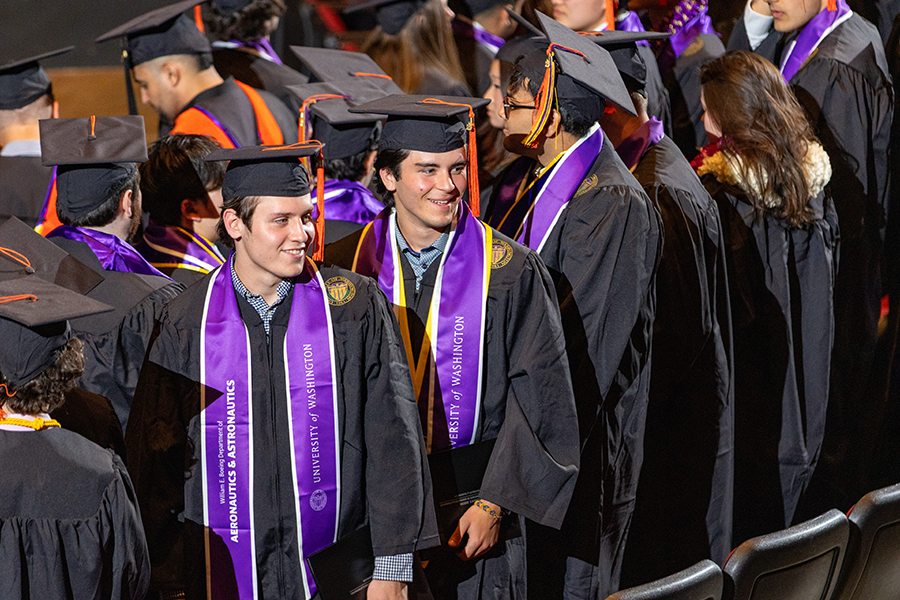
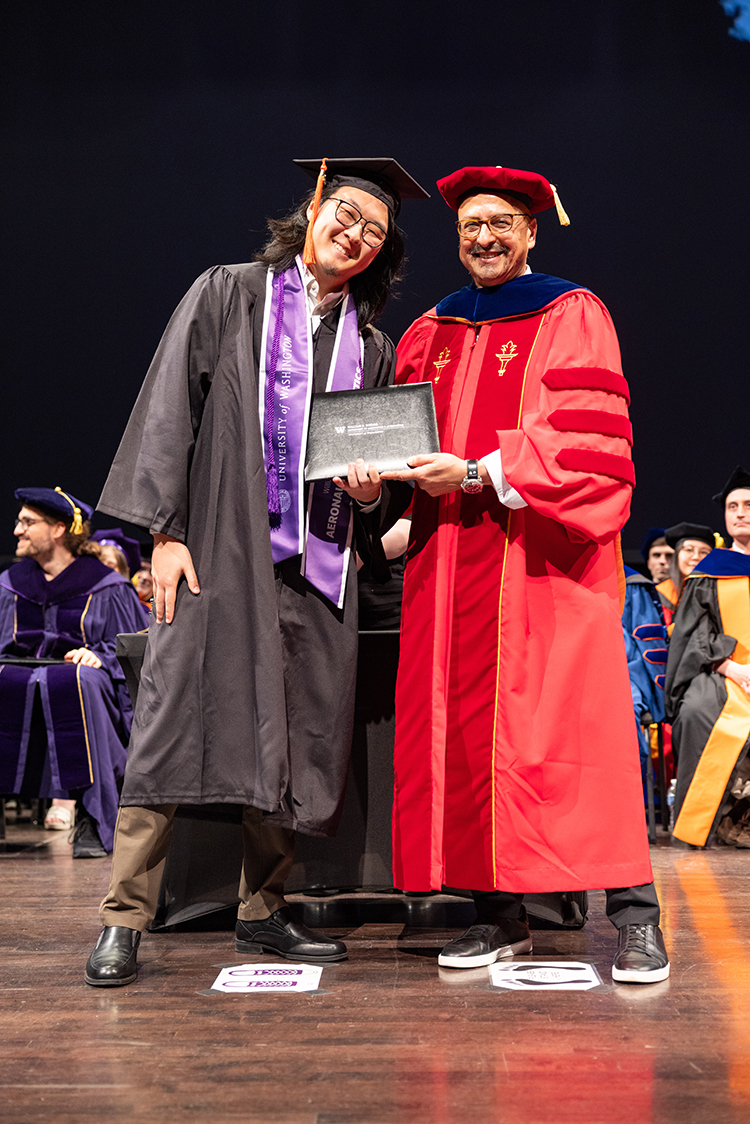
Jeffery Zhang's moment on the graduation stage with Interim Chair Professor Mehran Mesbahi (right).
The class of 2026 gave the department a lot to celebrate. But when three speakers took the stage, they pointed past the accomplishments to the classmates, friends, mentors, and families who made them possible.
During our department graduation, the class of 2026 heard from a graduating senior, a soon-to-be-hooded Ph.D., and an alum who sat where they sat almost three decades ago. The three didn't coordinate their remarks, but arrived at a similar place anyway. The technical work is real, but the people are what last.
Interim Chair Mehran Mesbahi began by placing the class in a busy moment for the field, where the problems faculty put in front of students are the same ones industry is racing to solve. He pointed to the department's own strong year, including two NSF CAREER Awards in the same year for faculty members Karen Leung and Ed Habtour. "This department is doing serious work," he told the graduates, "and you have been a part of it."
Undergraduate speaker Hugh Suratgar, who heads to CU Boulder this fall for a master's degree with an eye on flight testing, opened with "We made it." But the part he wanted his classmates to carry forward was not in any lab notebook. "It's not the hardware that I'll remember most," he said, "but rather the relationships I've made in this department that will stick with me for the rest of my life." In a field changing as fast as this one, he argued, connection is not a soft skill. "Human connection isn't just a comfort. It's what grounds us in empathy, honesty, and integrity."
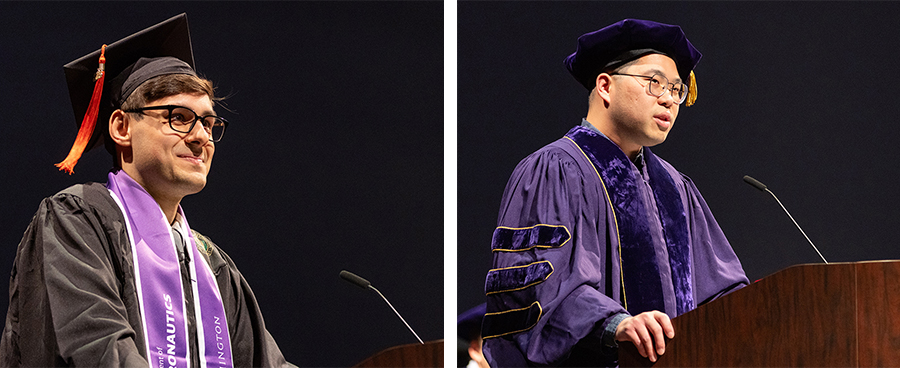
Undergraduate speaker Hugh Suratgar (left) and graduate speaker Kuang-Ying "Eddie" Ting.
Doctoral speaker Eddie Ting, a Boeing-Teslow Fellow whose research took on the aerodynamics and structural control of supersonic aircraft, took the same idea somewhere more personal. He spoke openly about failing classes, failing quarters, and being dismissed from a university before he found his footing. Engineers, he said, are trained to treat failure as information. "We all become experts in failure." The lesson he drew from his own record was for anyone in the room who felt behind. "Success does not only belong to the one with perfect records," he said, "but also to the ones who refuse to let their lowest moment define them." He had words for the friends who got him through, and a clear view of what tools cannot do. "AI might change how we work, but it cannot replace human connections." He closed with "The sky was never the limit. It was just the beginning."
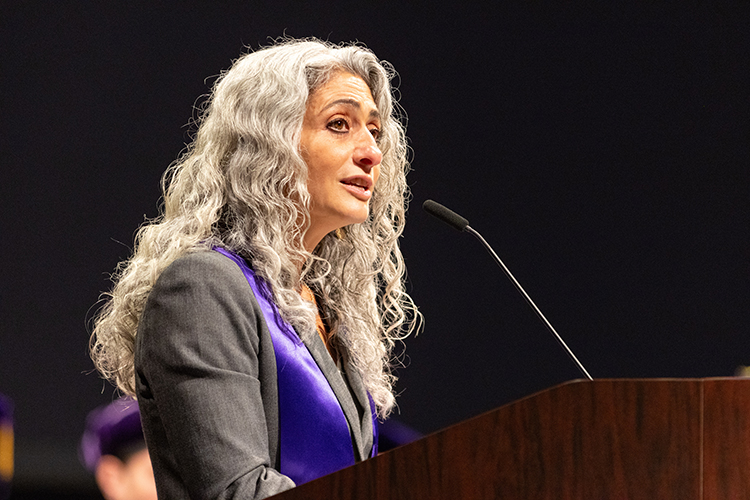
Keynote speaker and 2026 A&A Distinguished Alum Laila Elias.
Keynote speaker and 2026 Distinguished Alum Laila Elias, Ph.D. (BSAAE '98), had the longest view. Now vice president of Future Product Studies at Boeing, she has worked at NASA's Jet Propulsion Laboratory, Blue Origin, and across Boeing on everything from space telescopes to commercial aircraft. Her message to graduates started with the value of what they had just earned. "The education you just received is better than you think it is," she said, less for the equations than for the way of thinking behind them. From there she pointed to the same place the two student speakers had. "No one builds anything great alone," she said, naming collaboration as the most important skill an engineer develops.
Three speakers, at three different points on the same path, made one argument. Suratgar placed relationships above the hardware. Ting showed that failure is survivable and that the people beside you are the reason. Elias named collaboration as the skill that carries a career. The class of 2026 leaves trained to break hard problems into pieces and build them back better. The hardware will change. The people, all three speakers agreed, are what hold it together.