
Amy Sprague
May 19, 2026
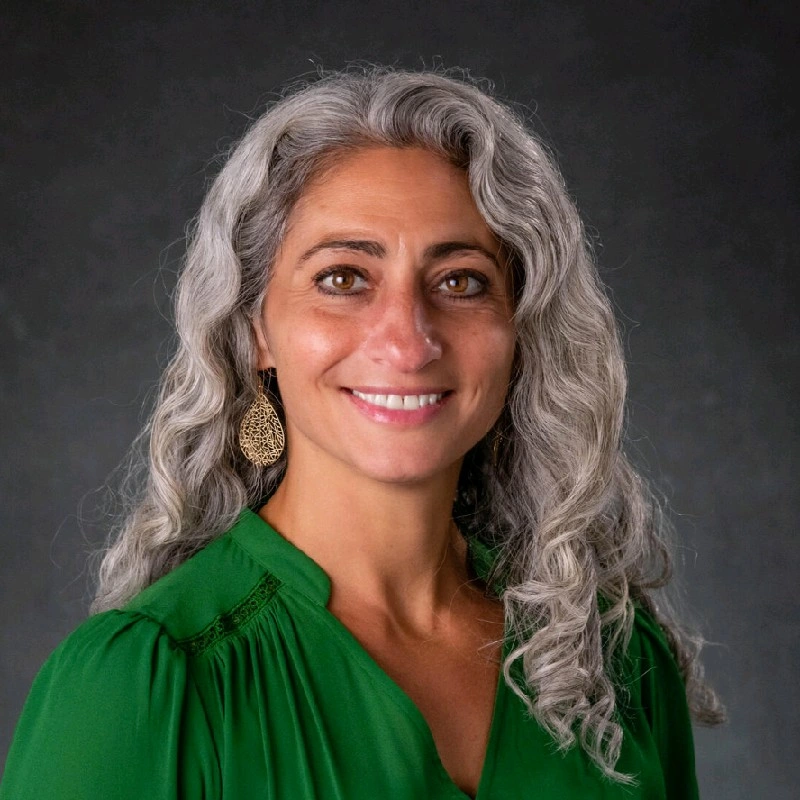
Laila Elias, Ph.D.
The moment Laila Elias (BSAAE ‘98) had worked toward for months came down to a sensation. She was aboard a 737 ecoDemonstrator, an active vibration control system she'd spent months developing primed for its first flight test. When the system switched on, she felt it right away: cabin vibration dropping, noise attenuating, data plots confirming what her body already knew.
"That's what engineering is all about," she says. "Seeing a problem, using analytical, design, test, and collaborative skills to come up with a solution, and then bringing the solution to life."
The William E. Boeing Department of Aeronautics & Astronautics is proud to name Elias its 2026 Distinguished Alum. Now Vice President of Future Product Studies at Boeing, she has built a career that spans NASA's Jet Propulsion Laboratory, Blue Origin, and multiple domains within Boeing — space telescopes, rocket engines, commercial aircraft — all held together by what she describes as "a passion for aerospace products, combined with the joy of collaborating with others to solve tough technical problems."
That curiosity took root at UW. Elias remembers paging through the course catalog as a new student, feeling both exhilarated and overwhelmed by how much there was to learn. "The hardest part was having to decide which classes to prioritize and which to postpone," she says. That mentality followed her into graduate school and throughout her career. She summarizes it in one word: curiosity.
Her undergraduate years were packed. She co-chaired the Women in Engineering peer mentoring program, interned at Lockheed Martin and AeroMech, and joined a research group studying whether a Water Vapor Adsorption Reactor could extract water from the Martian atmosphere to support a human crew. That project brought her team to a NASA conference in Houston, where they presented alongside veterans in the field, toured Johnson Space Center, and saw a Saturn V rocket up close. More than 20 years later, she's still in touch with those teammates. "The 'Mars nuts' still keep in touch," she says, "and occasionally reconnect on where all of our career paths have led."
Her favorite course was space design with Professor Adam Bruckner, which was the first time everything she'd absorbed across multiple subjects came together into something that resembled real engineering work. It was also, she notes, highly team-oriented. "That's reflective of how the industry works," she says. "And it offered a chance to get out of textbook space and into a creative, collaborative space."
That orientation toward collaboration has been a constant ever since. After earning her graduate degree at MIT and working at JPL on dynamics and controls for large, flexible space telescopes, she joined Blue Origin, where broad exposure across disciplines gave her a systems-level view of what it takes to build a space vehicle. Moving to Boeing, she brought that breadth to a new problem: vibration and noise on commercial airplanes. The ecoDemonstrator project required her to integrate across flight test teams, suppliers, and multiple engineering disciplines, all while developing a prototype under tight weight and space constraints. When it worked, she felt it.
The path from technical depth to executive leadership was gradual, driven by the same appetite that defined her as a student. "I couldn't help but want to learn more in other areas," she says. "Then I started to see the interconnections between the disciplines." She's careful to hold both modes of thinking in equal regard. Making real advances in aerospace takes deep technical experts and broad systems thinkers working in concert. "It takes both," she says.
Now her focus is the next 20 years. She sees continued momentum in fuel efficiency, alternative energy, electrification, advanced materials, and the commercialization of space. And she views AI as something engineers will need to understand as a native part of their work, not a separate tool. The engineers she's thinking about now will carry AI capabilities into products and workflows from the start, exercising what she calls "an AI-rich digital thread from design to advanced manufacturing to product operations."
Her advice to students coming up behind her echoes what the department gave her: get into practice early. More internships, more design-build projects, more undergraduate research. She wishes she'd made the leap from theory to application sooner herself. And when aspiring engineers ask her about paths that seem out of reach (she made it deep into the NASA astronaut selection process), her answer is the same. "Keep working hard toward the pursuit of your dreams," she says, "because they really are possible."
She'd know.