
Amy Sprague
May 18, 2026
On paper, they had the best plane in the world. Then they had to fly it. One year after a humbling 51st-place finish, the UW Design Build Fly team returned to the annual AIAA Design Build Fly competition with a new philosophy. And nearly won.
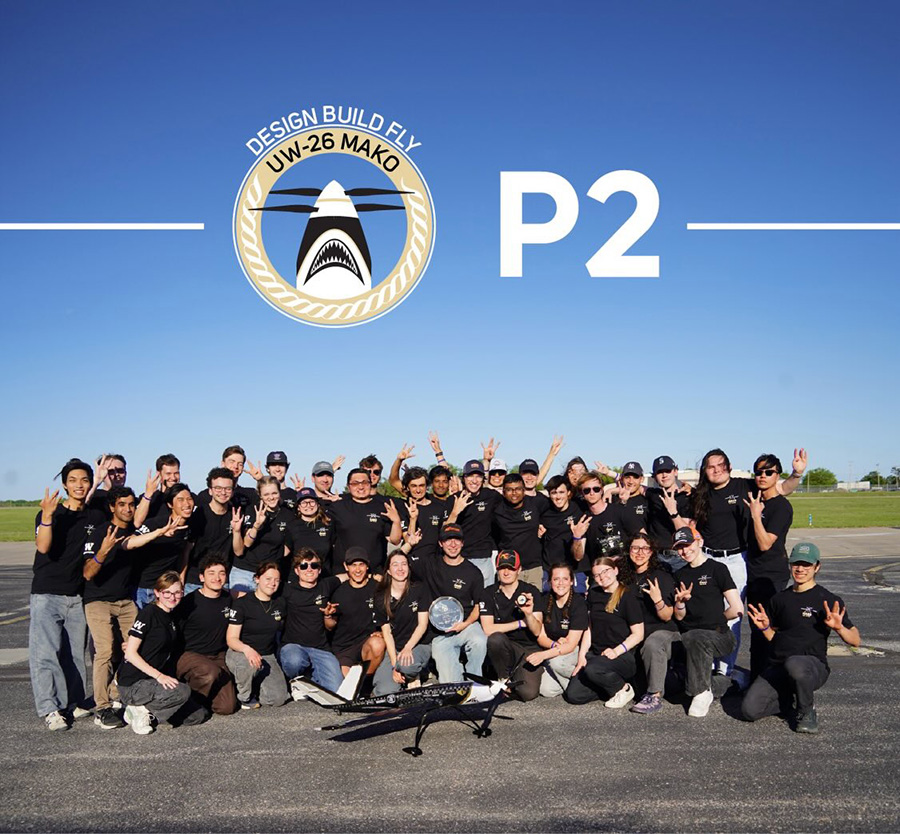
The team stops for a photo after at the end of competition.
Natalie Hagerman had practiced this 100 times.
Fold the banner. Secure the weights. Get the 20-foot strip of material tucked and tied onto the top of Mako, the UW Design Build Fly team's competition aircraft, in under five minutes. She could do it in two and a half, easy.
She had not practiced it in the 20-mile-an-hour Kansas wind.
"I have these four bags of tungsten weights and it's just flying away from me," Hagerman recalled. Standing next to her, technical director Kaleb Shaw was using his body to block the gusts as best he could. He could not touch the plane. Competition rules.
Hagerman got it done, barely, and the Mako went up. Then the banner didn't unfurl. On the flight line, 30 UW team members watched in silence as the plane came around on its first lap, the banner still furled tight. Alejandro Santana, the project manager, dropped to his knees.
Then it opened. The whole team erupted.
That moment, somewhere between disaster and triumph, captures what this year's Design Build Fly season was really about. After placing 51st out of roughly 100 teams at the 2025 competition in Tucson, the UW team came back with one goal: make it actually work. Not just on paper.
The lesson from Tucson
In 2025, the UW team had, in theoretical performance, the best aircraft at the competition. They had the lightest auxiliary drone and the greatest payload capacity, the two factors that determine your score when you complete a mission successfully. Based on what teams were declaring at technical inspection, UW had the performance to win.
They finished 51st.
The team's focus on theoretical performance had come at the cost of real-world testing. They had tested each system separately but never put the full mission together end to end, and a crash two weeks before competition wiped out their only remaining test window. At competition, a rushed fix compromised steering on rollout and the plane veered into the cacti. Foam backup wheels melted off the axle in the Arizona heat before the aircraft could even leave the ground. A short circuit grounded them on day two. By the last day of competition, after five missed flight attempts, the team had completed exactly one mission.
"The plane on paper would have won," said Hagerman. "And none of it mattered."
A different kind of goal
Last spring, with Hagerman newly elected as chief engineer, she and Santana sat down with one question: how do they make sure that never happens again?
Their answer was a deadline. The competition-spec airplane had to be finished six weeks before they left for Wichita, leaving time to fly it repeatedly and resolve every small problem before it became a large one.
"A relentless focus on reliability has really been the mantra this year," Santana said.
They built the full schedule backwards from that deadline and brought the leadership team in early, explaining not just what needed to happen but why. The team hit every deadline. They flew 88 times before competition, compared to 12 times the year before, chasing wind conditions and flying in the rain until the maneuvers were second nature.
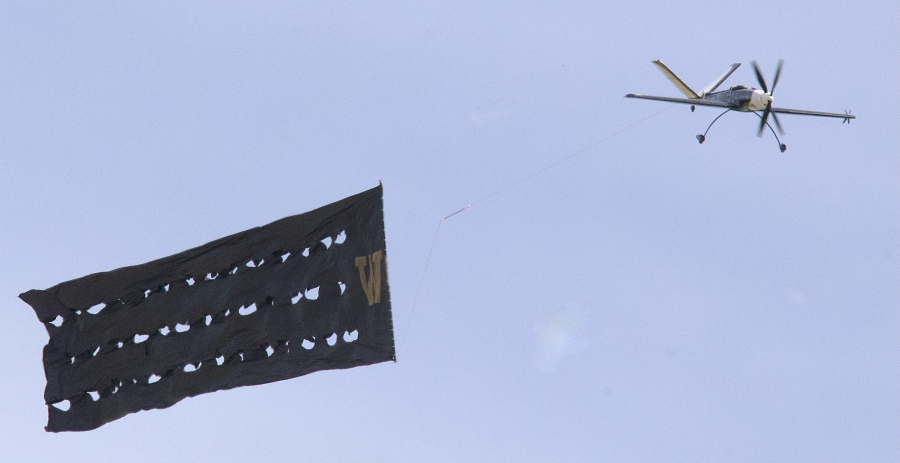
The UW team shined in Mission Three with their banner deployment, the largest in the competition. Photo credit: Missouri University of Science and Technology/Bob Phelan.
The Mako
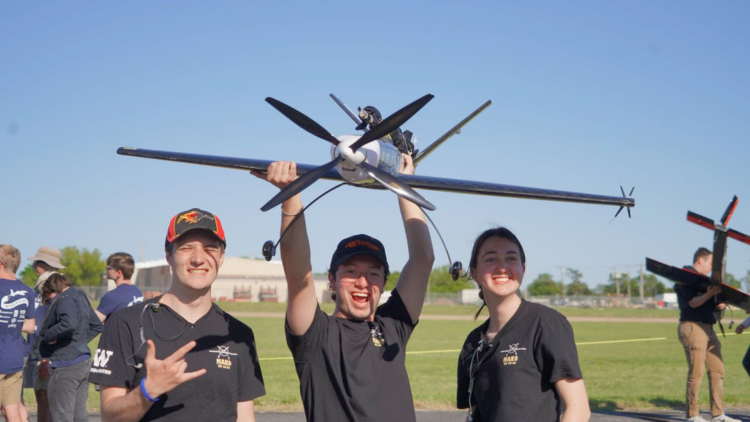
Technical Director Kaleb Shaw with Alejandro Santana and Natalie Hagerman on the tarmac with The Mako.
The aircraft they built is called the Mako, after the shark. The plane is small by competition standards, built around a single strategic insight: the banner mission scores laps flown times banner length, and a bigger plane meant more drag and fewer laps. The competition scores teams across three flight missions and a ground mission. The team decided early to minimize their payload in mission two, carrying just a handful of rubber ducks and hockey pucks, and pour everything into mission three: flying a massive banner as many times as possible.
To do that, the Mako needed to be efficient. The team invested in a contra-rotating gearbox, a dual propeller system that spins in opposite directions to improve efficiency, and designed a V-tail that clears the banner's path on deployment. The deployment maneuver requires the pilot to command a sharp pitch-up, release the latches, then pitch back down, essentially throwing the banner off the plane's back. In testing, it worked reliably.
A week before competition, the team cut small curved slits in the banner to reduce pressure drag. Testing confirmed a 17 percent improvement. They were the only team in Wichita to fly a slitted banner.
"When we showed the banner at the technical inspection on Thursday, the other teams asked, 'Is that even legal?’
"It absolutely is. We triple-checked,” Santana said.
Wichita, 2026
Watch AIAA’s video feed of UW’s first mission flight as they battled high winds in Wichita.
The flight line was closed Friday afternoon due to thunderstorms. The UW team knew they would have exactly one shot at each flight mission.
Hagerman stood on the flight line before the third and final mission and thought about the wind.
"And then I remembered we've flown 88 times this year," she said. "I took a deep breath and told myself: we've done this 88 times. This is just another one."
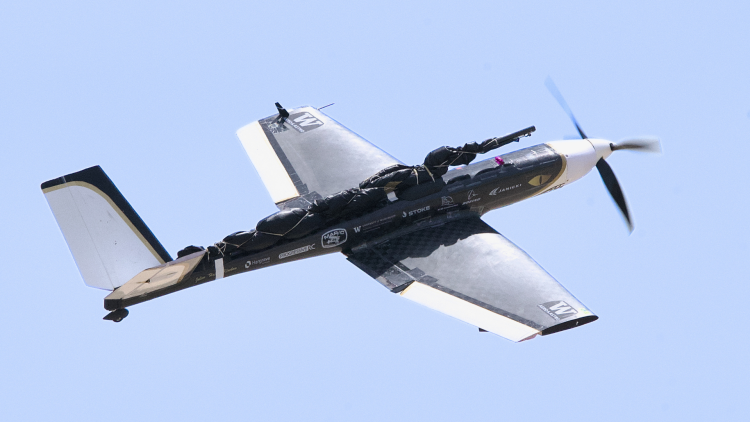
Mission two requires the carrying of passengers and/or cargo in the form of toy rubber ducks and hockey pucks. The team only fulfilled the minimum requirement of this mission so they could perform Mission Three with a smaller, lighter plane. Photo credit: Missouri University of Science and Technology/Bob Phelan.
Their pilot, Julien Klockow, navigated the gusts through all three missions. A wind gust mid-turn and a judge miscommunication added drama on mission three, but it didn't affect the outcome. UW posted the best mission three score of any team at the competition.
Final standing: second place, behind the University of Ljubljana. The Slovenian team has been placing near the top for several years and, as Hagerman observed afterward, did almost everything UW did, just a bit better. She came back from Kansas with a list of 20 things to try on next year's airplane.
"I'm actually really excited that we got second," she said. "There's still that next goal we want to hit."
Watch Day 2 and Day 3 missions.
The UW Design Build Fly team is a registered student organization in the William E. Boeing Department of Aeronautics and Astronautics. The team competes annually in the AIAA Design Build Fly competition.