
Amy Sprague
April 24, 2026
A&A Ph.D. candidate and 2026 Boeing-Teslow Fellow Kuang-Ying "Eddie" Ting has spent his graduate career in our UWAL wind tunnels figuring out how to keep wings under control.
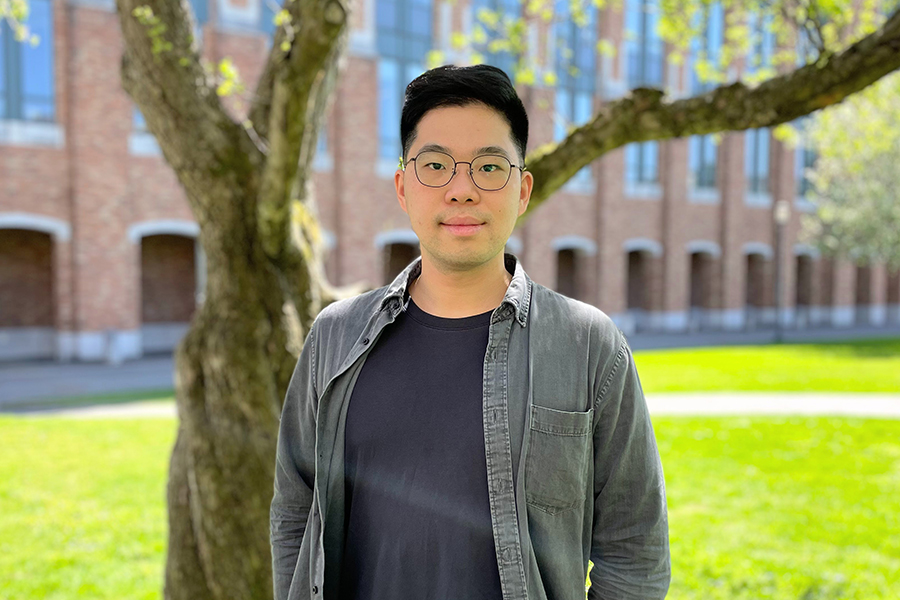
Kuang-Ying “Eddie” Ting
Wings flex. They always have. But as aircraft manufacturers push toward lighter composite materials and longer, slender wings optimized for fuel efficiency and high-speed cruise, they're building structures that flex more than ever. They bend. They vibrate. And under the wrong conditions, they can enter a destructive, self-amplifying oscillation called flutter that aircraft can’t survive.
Starting small in the 3x3
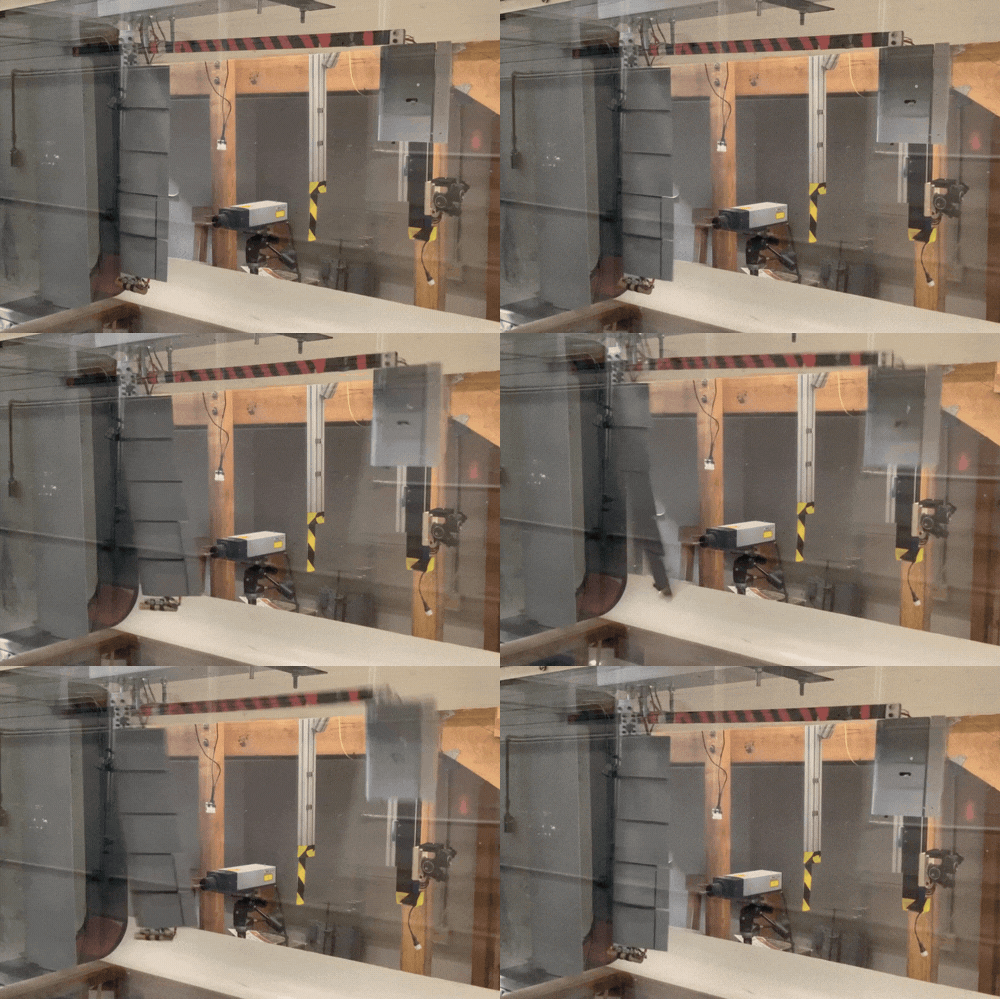
The MARGE-I flexible half-wing-body-tail model identifying open-loop flutter in our UWAL 3-foot by 3-foot low-speed wind tunnel.
Ting's flutter work starts in the UWAL 3-foot by 3-foot low-speed wind tunnel, where he tests MARGE-I (Model for Aeroelastic Response to Gust Excitation), a flexible half-wing-body-tail model designed for high-productivity runs. The model is deliberately compliant, built to behave the way next-generation composite wings do and susceptible to the same aeroelastic dynamics that engineers need to understand before they can design against them.
Testing flutter directly is dangerous. Ting says, "You can't simply push a wing to its breaking point and observe what happens." Instead, he uses a "destabilize/stabilize" technique: one set of control surfaces deliberately induces what he calls synthetic flutter, creating realistic oscillations while the wind speed stays safely below actual flutter speed. Then his software, built around H-infinity robust control theory, takes over, automatically moving ailerons and elevators to read the motion and damp it out in real time.
The approach matters because mathematical models of flexible structures are never perfect. By validating control laws in a real fluid environment rather than simulation alone, Ting can demonstrate that the system works even when the model is slightly wrong.
Into UWAL's Kirsten Wind Tunnel
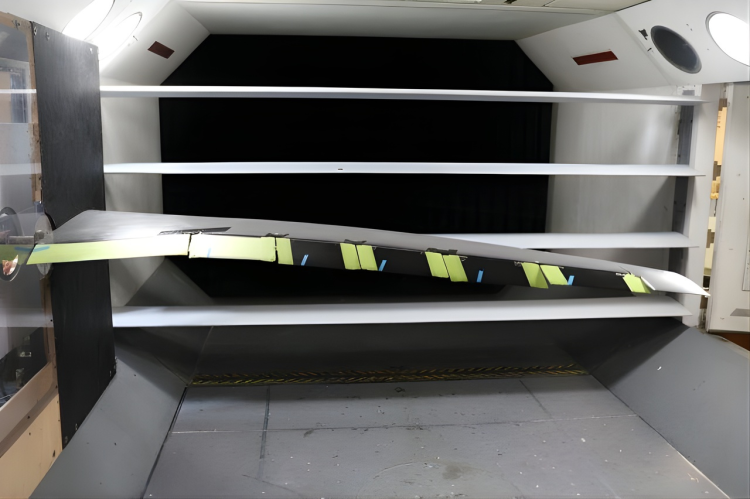
The LARGE Flexible Wing model, a high-aspect ratio (8.36) model in UWAL’s Kirsten Wind Tunnel.
Larger-scale work moves to the Kirsten Wind Tunnel, our 12-foot by 8-foot facility that has operated on the UW campus since 1936. There, Ting tests the Large Flexible Wing, a high-aspect-ratio model representative of modern transport aircraft.
His focus here shifts from flutter suppression to gust load alleviation, which is managing what happens when turbulence hits. On a wing that can flex dramatically in flight, a sharp gust doesn't just rattle the passengers; it loads the wing root with forces that accumulate into structural fatigue over thousands of flight cycles.
Ting's system senses incoming gusts before they hit and actuates the multiple control surfaces on the wind tunnel model to suppress the resulting vibrations and dynamic stresses. Control robustness means the system can handle a range of gust scenarios. This is important for real aircraft, where atmospheric turbulence rarely follows a script.
"When we shake inside the cabin, it’s the whole aircraft that is shaking." Ting says, “The goal is to address both problems at once: protecting the airframe and smoothing the ride.
The LARGE model undergoes frequency sweep for system identification.
The supersonic problem
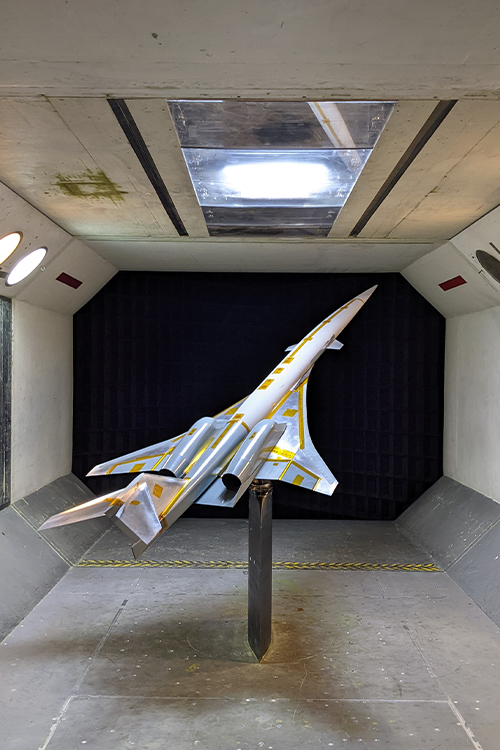
The SCALOS 2020 three-surface low-boom concept with extended forward fuselage, nacelles on top, T-tail, ogive leading edge, and nozzle-shock reflecting deck.
Ting's third project follows the same approach, integrating analysis, simulation, and physical testing to understand aerodynamic behavior that’s different to predict from theory alone. A supersonic airliner optimized for efficient Mach 1.8 cruise with a reduced sonic boom is, by necessity, long and slender. Those same shapes perform poorly at the low speeds required for takeoff and landing. SCALOS (Supersonic Configurations at Low Speeds), sponsored by NASA, is about understanding those aerodynamic design tradeoffs between high speed and low speed configuration shapes.
Over 226 test runs in a single campaign, Ting and the SCALOS team documented how representative supersonic airliner configurations behave at low speeds, testing different wing planforms, area-ruled fuselages, and high-lift devices including wing fences and nose chines.
Structures, aerodynamics, controls
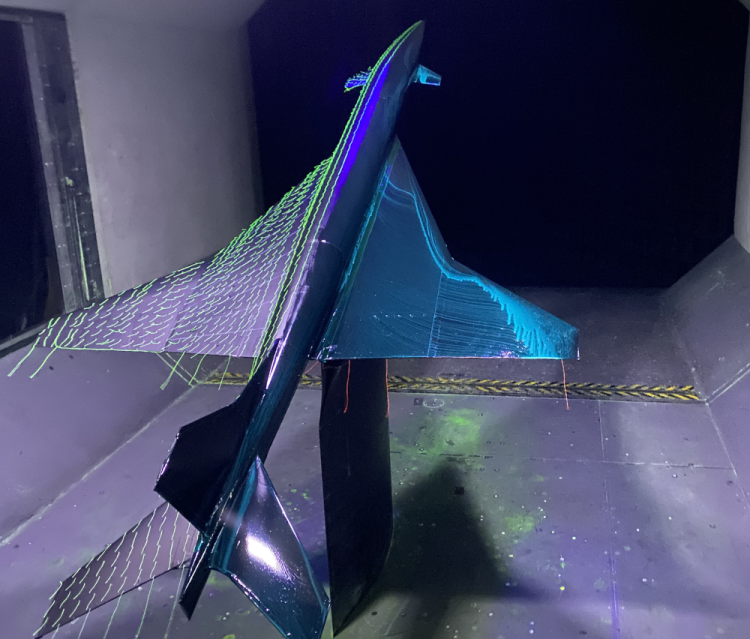
Flow visualization on the SCALOS 2021 baseline model using mini-tufts (left) and fluorescent oil (right) for off-surface flow and surface flow, respectively.
Across all three projects, Ting is doing the same fundamental thing: testing whether the math works when the wind is blowing. One of his faculty advisers, Professor Eli Livne, says, "Eddie is working at the intersection of structures, aerodynamics, and controls, which is where some of the hard problems in flexible aircraft design live. The wind tunnel work is essential. You can build the most sophisticated math models in the world, but at some point you have to put test models in real airflow and find out how well the math models capture physical reality."
"The Boeing-Teslow Fellowship has really allowed me to focus on finishing my dissertation," Ting says. It’s a fitting end to his extensive research ranging from subsonic flutter to supersonic cruise in the department.The wings of tomorrow will flex. His work is making sure they don't break.
The Boeing-Teslow Fellowship is supported by two sources. Boeing's fellowship supports graduate student education and research in the department. The James L. Teslow Endowed Fellowship supports Ph.D. candidates in the department whose work applies aerospace disciplines to space exploration.
Flow visualization on the SCALOS 2020 baseline model using smoke and laser sheet for off-surface vortex visualization.
Go to the sources
Aeroservoelastic Wind Tunnel Evaluation of H∞ Active Flutter Suppression
Kuang-Ying Ting, John Berg, Mehran Mesbahi, and Eli Livne
AIAA 2026-1058
Session: Flutter and Limit-Cycle Oscillations II
Published Online:8 Jan 2026
Supersonic Configurations at Low Speeds (SCALOS): Results and Insights from the 2024 Wind Tunnel Test Campaign
Kuang-Ying Ting, Kenneth C. Wiersema, Reza Soltani, Chester P. Nelson, and Eli Livne
AIAA 2026-2639
Session: Supersonic Ground and Flight Testing
Published Online:8 Jan 2026
Wind Tunnel Low-Speed Tare and Interference Corrections: CFD vs Test Results - The Supersonic Configurations (SCALOS) Cases
Kenneth C. Wiersema, Kuang-Ying Ting, Eli Livne, Chester P. Nelson and Reza Soltani
AIAA 2026-2640
Session: Supersonic Ground and Flight Testing
Published Online:8 Jan 2026