
Amy Sprague
April 14, 2026
Joe Armas came to the UW to study aerospace. He went on to work with missiles in the Army, then spent 20 years solving problems most engineers never see — at Otis Elevator.

The Space Needle is the first tower in the world to have double deck, floor-to-ceiling glass elevator cabs. In a great feat of engineering, Otis Elevator constructed and installed them.
It started at 11 o'clock at night. A ship crane had been mounted at the top of Seattle’s Space Needle. At ground level, a second crane waited. The plan: lift an elevator cab, transfer it mid-air, raise it to the top of the Space Needle, lower it into its hoistway, then do the whole thing again with a second cab, attaching the two as a double-stack. Nobody had done it before. The team started at 11 p.m. and finished twelve hours later.
"When the owners of the Space Needle said they wanted to do that, we wondered, can we actually engineer this?" said Joe Armas (A&A ‘98), president of Otis Americas. "We had no idea how to do this."
They figured it out.

Joe Armas
A pivot he didn't plan
Armas graduated from A&A in 1998 from a department that, by his recollection, had fewer than 20 students per cohort, which is considerably smaller than today’s 70-plus student cohorts. Through ROTC at Clark Hall, he went directly into the Army's Air Defense Artillery, operating Patriot missile systems through deployments to Kuwait, Saudi Arabia, and Iraq. Radar technology, system design, safety-critical thinking under pressure. "It fell right in line with what I was learning at UW," he said.
When he transitioned out of the military, he joined United Technologies, which at the time owned Pratt and Whitney, Sikorsky, and a company called Otis Elevator. "I figured I'd work on elevators for about a week," he told students during a recent A&A seminar, "and then I'd be working on jet engines the next month."
That was more than 20 years ago. Otis is now an independent company, the largest elevator manufacturer in the world, moving roughly 2.5 billion people a day.
“ The human interface is the hardest challenge. You expect everybody to behave a certain way, and that just doesn't happen.”
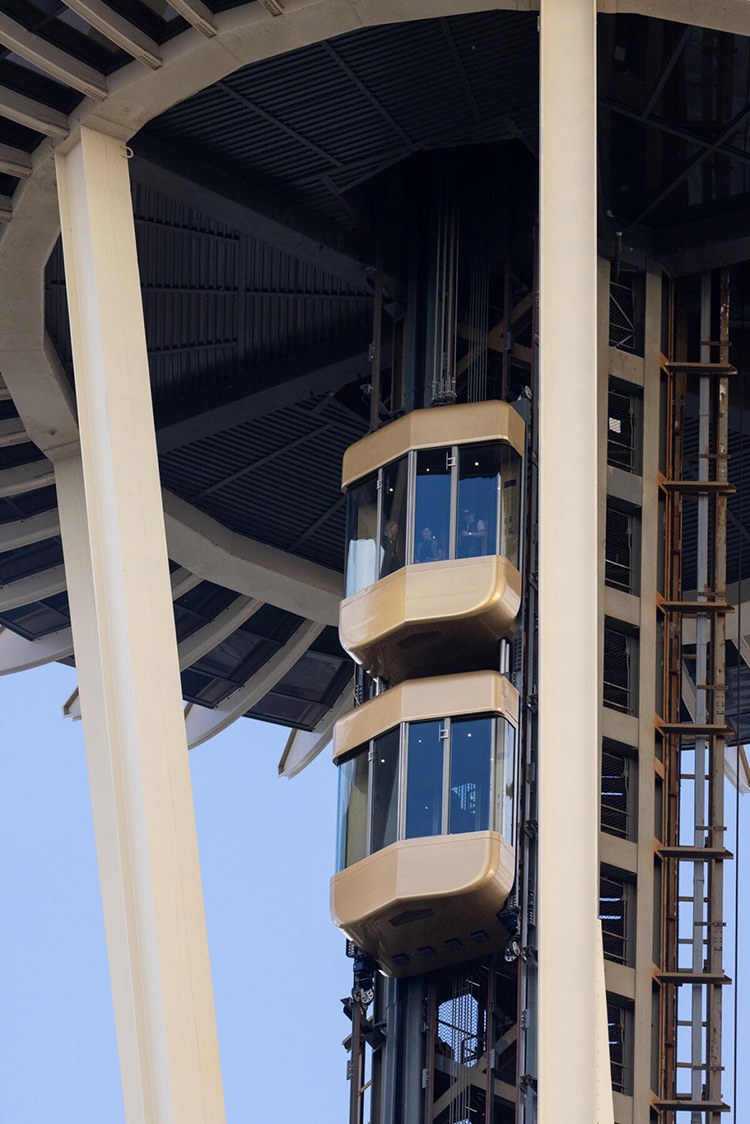
A close-up of the Space Needle's unique double deck elevators.
The engineering is familiar
The problems Armas works on would be recognizable to any aerospace engineer. Stack effect and piston dynamics in super-tall buildings are essentially aerodynamics. Buildings over 500 meters sway enough to introduce resonance in any system hanging inside them. Material selection on a sheave — what to use when a rope crosses it thousands of times a day — isn't so different from the materials questions aerospace engineers face.
Then there's the dispatching problem: how to move thousands of people through a building efficiently using AI models trained on real-world traffic patterns. Otis now has about 1.2 million elevators connected globally, and the data those connections generate feeds algorithms that can predict building traffic with about 90 to 95 percent accuracy.
Armas gave students a sharp example. A major finance firm located in New York City, after opening its new New York headquarters, found employees were consistently late returning from lunch. The elevators couldn't handle the noon rush. Facilities managers brought in actuaries. Otis looked at the traffic data and suggested offering a 20 percent lunch discount 45 minutes before the peak. The firm did. The curve flattened immediately, almost exactly as the model predicted. No new hardware, no new elevators. Just a better understanding of the system and the people inside it.
The versatility of the aerospace degree
What his career suggests is that the destination is hard to predict, but the toolkit travels. Aerodynamics, materials, data systems, safety-critical thinking under pressure are not exclusive to aerospace. The Space Needle job, the finance firm’s lunch curve, whatever comes next: they all follow the same logic. An unfamiliar problem and a skilled team that figures it out.
"Here I am, twenty-plus years later, still working around elevators," he said.