
Amy Sprague
April 6, 2026
In a wind tunnel, you can measure fast or you can measure well. High-resolution imaging captures fine detail but misses rapid motion. Fast sensors catch the dynamics but only at a single point. For decades, aerospace engineers studying turbulence have had to choose one or the other, and live with the gaps. Kevin Manohar, the department's 2026 Varanasi Scholar and doctoral researcher in A&A’s Williams Turbulence Lab, is closing those gaps.
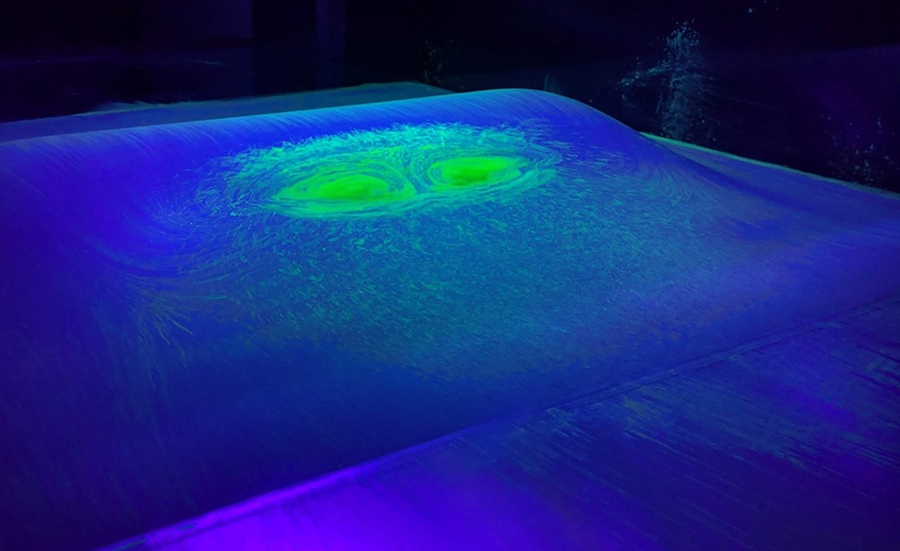
Flow visualization on the Boeing Gaussian bump geometry, showing a conventional flow in our 3X3 Wind Tunnel, using fluorescent dye in a china clay and kerosene mixture. Manohar’s work focuses on reconstructing the rapid, hidden dynamics these traditional methods can’t capture in real time.
Kevin Manohar
Manohar’s research centers on flow separation, the phenomenon where air peels away from a wing's surface during takeoff, landing, or aggressive maneuvers, generating drag and pushing aircraft toward the edges of their performance envelope. Turbulence makes this hard to study. It operates across scales simultaneously, sweeping structures and tiny rapid eddies all interacting in ways that standard models struggle to capture.
"We still don't understand these flows well," Manohar says. "When we try to study them in wind tunnels, we can only capture partial measurements. My aim is to reconstruct these flows from those partial measurements to get a better understanding, with the eventual goal of controlling them."
Manohar's solution draws on machine learning, but not the kind that simply finds patterns in data. His models are trained on physics. Using neural network architectures related to those behind modern language AI, he reconstructs sparse experimental data through a process called temporal super-resolution, filling the gaps between slow snapshots to produce a continuous, high-speed record of how air actually moves. The models are constrained by the fundamental equations governing mass and momentum, so the reconstructions stay physically accurate.
The approach is already revealing things that conventional measurements can't see. In experiments using the Boeing speed-bump geometry, a simplified shape designed to replicate airflow over high-lift wings, Manohar's tools uncovered a mechanism called amplitude modulation. A slow, meandering motion in the flow turns out to govern how energy is distributed among faster oscillating behaviors in the wake. Without the reconstructed data, that connection stays hidden.
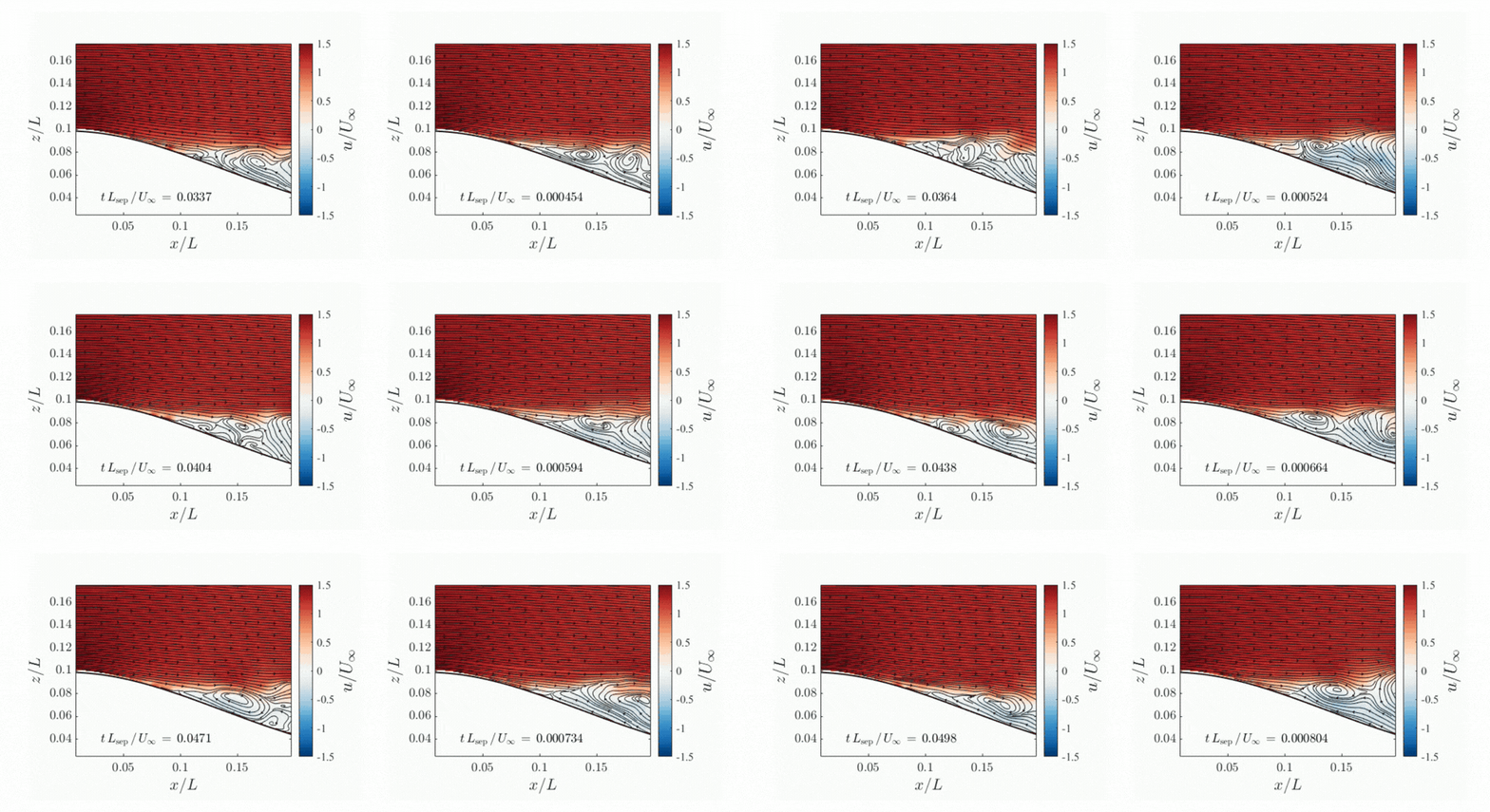
These videos illustrate the temporal upsampling applied to turbulent separated flow over the Boeing Gaussian Bump (Particle Image Velocimetry data collected in the 3x3 tunnel). The flow is going from left to right over the bump and is separated off the surface. The left video filmed at 15 Hz looks like uncorrelated snapshots. The upsampled 2000 Hz video on the right shows the spatial evolution of the vortical structures much more clearly. We have slowed the video on the right down to highlight all of the details that the original version on the left could not show.
"These tools reveal hidden dynamics that cannot be observed directly with conventional measurements," Manohar explains.
Once a model is fully trained, the implications stretch further. Manohar's approach correlates expensive laser-based imaging with inexpensive wall-mounted pressure sensors, each costing around $50, that record the flow's surface imprint at high speed. After training, the cameras aren't needed anymore.
"You just have the sensors installed, run the experiment, and you have real-time video, effectively," he says.
That work is now extending into UWAL's Kirsten Wind Tunnel, where Manohar is collaborating with Boeing on a new high-lift wing model with other graduate students in emerging diagnostic techniques, including temperature-sensitive paint, which captures instantaneous surface signatures of airflow in real time.
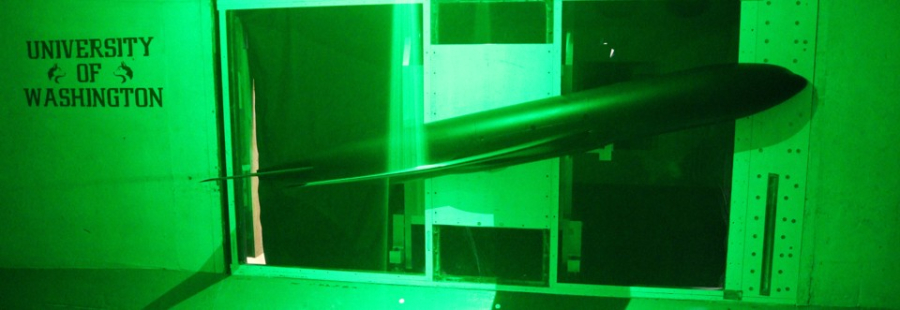
Laser-based imaging of a wind section using planar particle image velocimetry (PIV) on a High-Speed Common Research Model (HS-CRM) in UWAL’s Kirsten Wind Tunnel. Manohar and his research team are preparing similar experiments that will combine this high-resolution PIV imaging with simultaneous wall-pressure sensing on a new high-lift model in collaboration with Boeing, including a temperature-sensitive paint campaign in the future.
Manohar’s faculty adviser Associate Research Professor Owen Williams says, "Kevin's work is distinctive because he bakes the physical constraints into the model from the start, which gives us confidence that what we're seeing in the reconstructions is real and can be interpreted."
Manohar’s longer arc points to developing digital twins, virtual replicas of physical aircraft with enough fidelity to support real-time diagnostics and guide the design of cleaner, more resilient aircraft. Turbulent separated flows at the edge of the flight envelope are among the costliest problems in aircraft certification, consuming significant design time and requiring expensive large-scale wind tunnel tests. Better models mean better predictions earlier in the process and better results when the model finally does undergo testing in the wind tunnel.
"These techniques are very upstream in the design process," Manohar says, "and that's where they need to be for the biggest impact."
The Varanasi Endowed Fellowship was established by Rao (Ph.D ‘68) and Usha Varanasi (Ph.D. Chemistry ‘68) to help support A&A students with academic merit in our graduate program. The Varanasis are well-known at the UW for their service to our programs. In 2017, they were named UW Laureates. In 2019, Rao was named the A&A Distinguished Alumnus, and in 2022, the College jointly awarded them the Diamond Award for Distinguished Service.