Research Areas
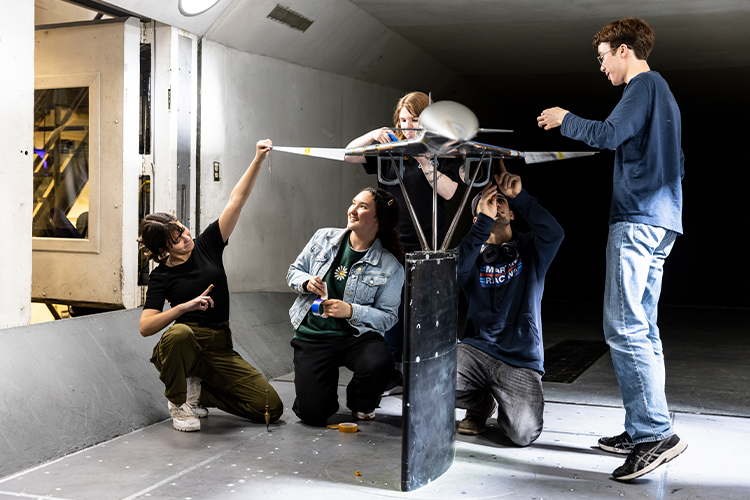
Aerodynamics and fluid mechanics will continue to pace developments in the aerospace and aerospace-related industries. Department research in these areas covers a wide spectrum from analytical to experimental development of models for vorticity- dominated flows. These areas include turbulence modeling studies using experimental methods, novel diagnostic development, vortex breakdown, mixing in combusting and non-combusting environments, accelerating turbulence, and boundary-layer control through use of stationary vortices. Other projects use existing fluids technology in new applications which are referred to under other headings. The successful development of hypersonic vehicles represents another important challenge in air breathing propulsion. Research in this area explores novel strategies for promoting effective fuel injection and fuel/air mixing in supersonic flows.
Almost every engineering or physical system needs control in some form or another to improve performance as well as robustness with respect to disturbances and model uncertainties. Systems requiring control can range from the more conventional electromechanical systems (e.g., aircraft, spacecraft, robots, actively controlled structures, manufacturing processes, power generation) to biological systems (e.g., natural resource management, medical support systems involving patients). Our research interests include the fundamental techniques for design and analysis of control systems for such diverse applications. Because controls spans such a wide range of applications, the controls program at the UW is cross-departmental, with students and faculty from Aeronautics and Astronautics, Electrical Engineering, and Mechanical Engineering cooperating closely in research and education. Research activity spans modern model-based techniques for multivariable systems (direct optimization based methods, robust design methods) as well as investigation of unconventional approaches based on artificial neural networks, fuzzy logic and genetic algorithms.
The energy and power available play a dominant role in the characteristics of all vehicles. Ground transportation, atmospheric and space flight vehicles depend on primary resources such as fuels for the accomplishment of their missions. The conversion processes of fuel energy to useful forms, such as jet power, must be efficient, low in environmental impact, and economically viable . The fundamentals of energy interactions with fluids are critical to the successful design of power and propulsion, and analysis of engines, turbo machinery, magnetohydrodynamics, power generation in space, nozzle flows, photovoltaics, and lasers to mention a few. Active programs in energy research include the study of technologies for the efficient, low-emission combustion of hydrocarbon fuels.
Application of high-energy flow to propulsion, gasdynamic and chemical lasers, and chemical production requires a detailed knowledge of kinetics of vibrational and electronic energy transfer, radiation cross-sections, and chemical rate processes. The Aeronautics and Astronautics faculty are engaged in fundamental studies of these processes, along with the development of computational tools for modeling them in high-enthalpy, non-equilibrium flow.
Heat transfer is a critical element in a wide variety of aerospace applications. Key areas under study in the department include convective and radiative heat transfer to conical bodies at high Mach number flight, analysis and measurement of the effects of thermal boundary layers on the performance of gasdynamic chemical reactors, and the development of novel technologies for managing waste heat from thermal power systems in space.
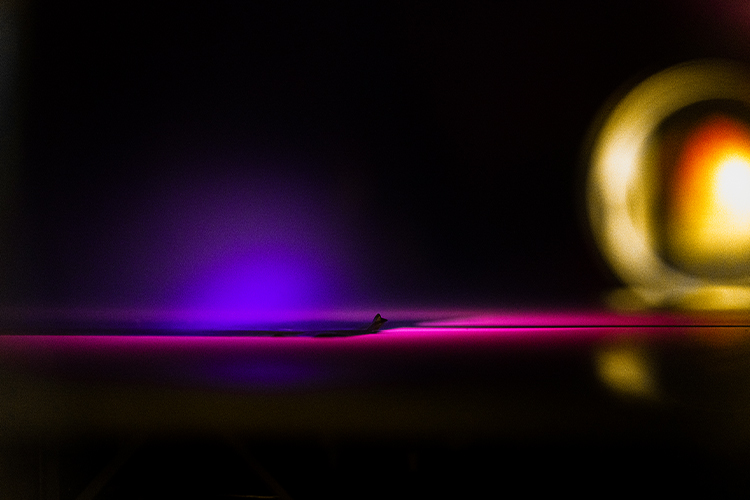
The plasma physics group’s primary interest is nuclear fusion, particularly new confinement concepts and innovative improvements to tokamaks. The current research involves flowing plasmas, and is thus related to fluid mechanics and magnetohydrodynamics (MHD). Interests also extend to plasma propulsion. In the area of new confinement concepts, an ongoing area of investigation is compact toroids, which have the ability to make considerable simplifications in fusion reactor design. Fundamental plasma questions involve helicity conservation and its effect on confinement, and sheared plasma flows and kinetic particles and their effects on stability. Current research involves the use of helicity injection to sustain the current in spherical tokamaks and spheromaks, rotating magnetic fields to create and sustain FRCs, high density Z-pinches stabilized by sheared plasma flows, the acceleration and compression of theta-pinch formed FRCs, and novel electrostatic thruster concepts. There is also a significant effort on computational algorithm development for advanced plasma models, theoretical analysis, and MHD code development.
The study of solid mechanics deals with the behavior of solid materials: the deformations, motions, and internal states of solids and structures that arise in their use in some engineering applications. Aerospace structures are unique in their challenging light weight/high performance requirements. Examples are apparent all around: the bending of a composite airplane wing under wing loadings, the internal stresses in the booster rocket during a space vehicle launch, the action of a piece of space debris impacting a space vehicle. To design such applications requires an underlying understanding of the theoretical mechanics of solids, effective means for applying that theory to predict the response of a structure to all conditions expected in its intended application, and effective design optimization capabilities that can optimize an objective or a set of objectives subject to constraints that protect against all possible failure modes.