
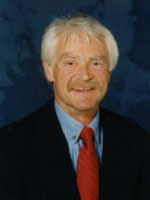
Aeronautics & Astronautics
Juris Vagners

Professor Emeritus

vagners@aa.washington.edu
Office: 318A Guggenheim
Phone: (206) 616-3590


University of Washington
BOX 352400
Seattle, WA 98195-2400

 
Related Links


Research Fields
Associated Labs
Background

Professor Vagners completed his undergraduate studies at the University of Washington in Aeronautical Engineering in 1961. He then went to Lockheed Missiles and Space Company to work on satellite programs and pursue graduate studies at Stanford University under the Honors Cooperative Program. He received his doctorate degree from Stanford in Aeronautical and Astronautical Sciences in 1967. Professor Vagners joined the faculty at the University of Washington in the Department of Aeronautics and Astronautics in 1967. From 1982 to 1990, he held a joint appointment in the Applied Mathematics Department, and was Adjunct Professor in Electrical Engineering from 1994 to 2002. Professor Vagners retired from full time duties September, 2002, and remains active on various research projects.


Research Activities

Professor Vagners' research interests have been in the application of unconventional control techniques, i.e., artificial neural networks, fuzzy logic and evolutionary programming, to control systems design. Most recently, his research has focused on autonomous and semi-autonomous vehicle systems. In 1998 he collaborated with The Insitu Group on the first crossing of the North Atlantic by a robotic aircraft. The Aerosonde Laima , at ten foot wing span and gross take-off weight of 29 lbs, was not only the first, but by far the smallest aircraft to accomplish such a historic feat. The crossing took 26 hours and 45 minutes and consumed one and a half gallons of aviation gasoline. Since then he has been working on cooperative path and mission planning for systems of multiple heterogeneous unmanned vehicles. These systems may be comprised of Unmanned Aerial Vehicles (UAVs), Unmanned Surface Vehicles (USVs), Unmanned Underwater Vehicles (UUVs) and Unmanned Ground Vehicles (UGVs). Integration of human operators in such systems is a key research issue.

Professor Vagners also has an active consulting practice with sports equipment manufacturers on the biomechanical and mechanical aspects of the dynamics of sports equipment such as skis, snowboards, and high speed windsurfing equipment. This activity results from a lifelong interest and participation in these sports, as well as the observation that the human is still the best and most effective controller for most dynamic systems, and electromechanical control systems are only a poor approximation to the human operation.


Selected Publications

  1. B. Capozzi, J. Vagners, Navigating Annoying Environments Through Evolution, 40th IEEE Conference on Decision and Control, Orlando, Florida , December 4-7, 2001,
  2. B. Capozzi, J. Vagners. Evolving (Semi) Autonomous Vehicles, AIAA 2001 Guidance, Navigation and Control Conf. Montreal, Canada, Aug. 2001
  3. T.McGeer, J. Vagners, Wide-scale use of long-range miniature Aerosondes over the world's oceans, Proc. AUVSI 26th Annual Symposium, Association for Unmanned Vehicle Systems International, Baltimore, Md, July, 1999
  4. J. Vagners, T. McGeer, L. Newcombe, Quantitative Risk Management as a Regulatory Approach to Civil UAVs, International Workshop on UAV Certification, Paris, France, June, 1999
  5. T. McGeer, J.Vagners, and G. Holland. The Aerosonde: opportunities for miniature robotic aircraft following the 1998 Atlantic Crossing. 4th Annual Airborne Remote Sensing Conference and Exhibition/21st Canadian Symposium on Remote Sensing, Ottawa, Ontario, 21-24 June 1999
  6. K. Bohringer, M. Campbell, J. Vagners AI Based Satellite Constellations, American Association for Artificial Intelligence (AAAI) Spring Symposium Series, March, 1999
  7. T. McGeer and J. Vagners, Historic crossing: an unmanned aircraft's Atlantic flight. GPS World 10(2): 24-30, February 1999.
  8. A. Pongpunwattana, R. Rysdyk, J. Vagners, D. Rathbun, Market-based Co-evolution Planning for Multiple Autonomous Vehicles, 2nd AIAA Unmanned Systems Conf. San Diego, CA Sept 2003
  9. Q.Y.I. Smithwick, P.G. Reinhall, J. Vagners, E.J. Seibel, A Nonlinear State-Space Model of a Resonating Single Fiber Scanner for Tracking Control: Theory and Experiment, ASME Journal of Dynamic Ssytems, Measurement and Control, Vol 126, March, 2004
  10. D. Jia, J. Vagners, Parallel Evolutionary Algorithms for UAV Path Planning", AIAA 3rd "Unmanned Unlimited Technical Conference, September 20 -23, 2004, Chicago IL
  11. J.C. Rubio, J. Vagners, R. Rysdyk, Adaptive Path Planning for Autonomous UAV Oceanic Search Missions, AIAA 3rd "Unmanned Unlimited" Technical Conference, September 20 -23, 2004, Chicago IL